LISTEN TO THE PLACE
A story worth knowing
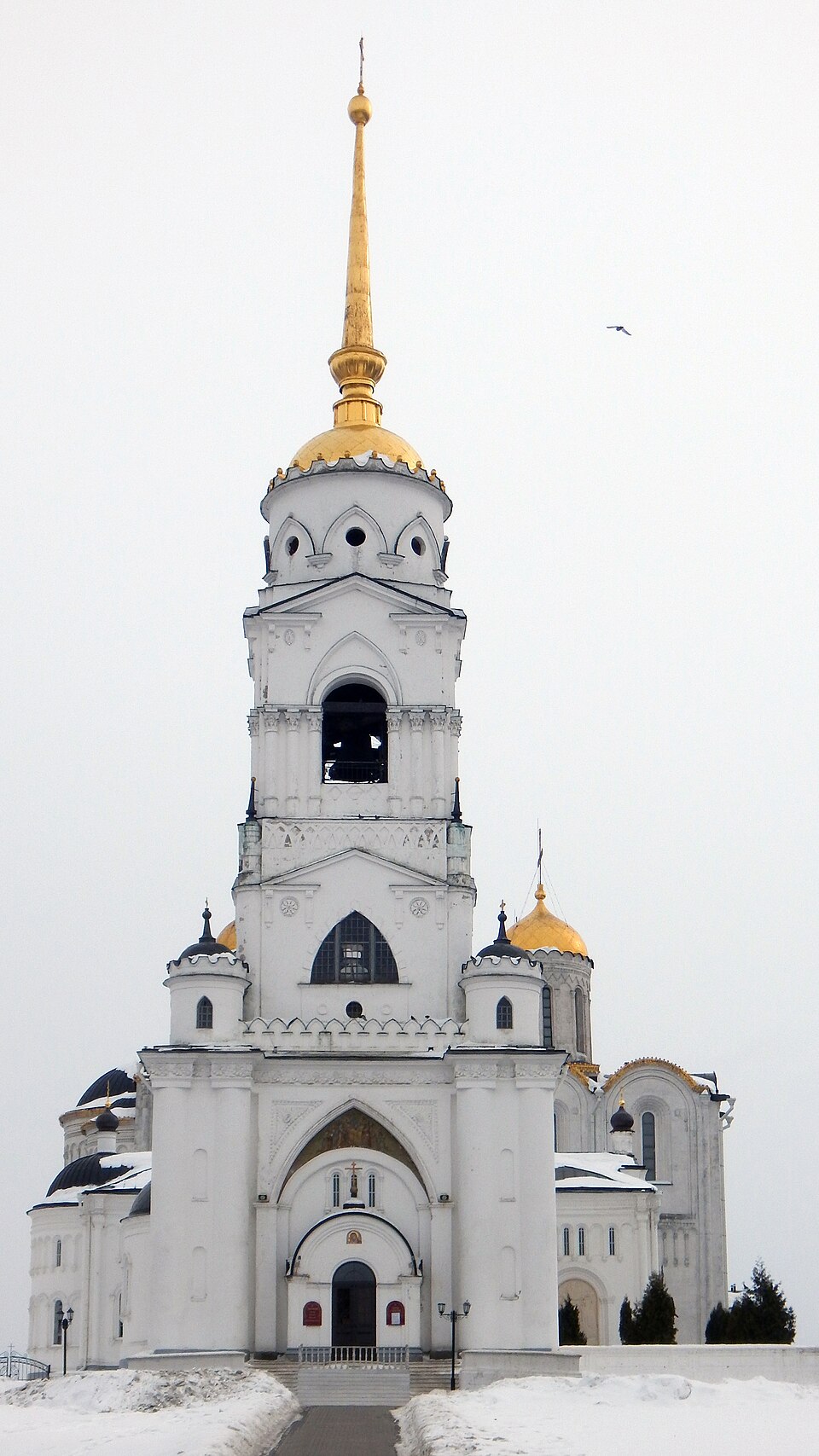
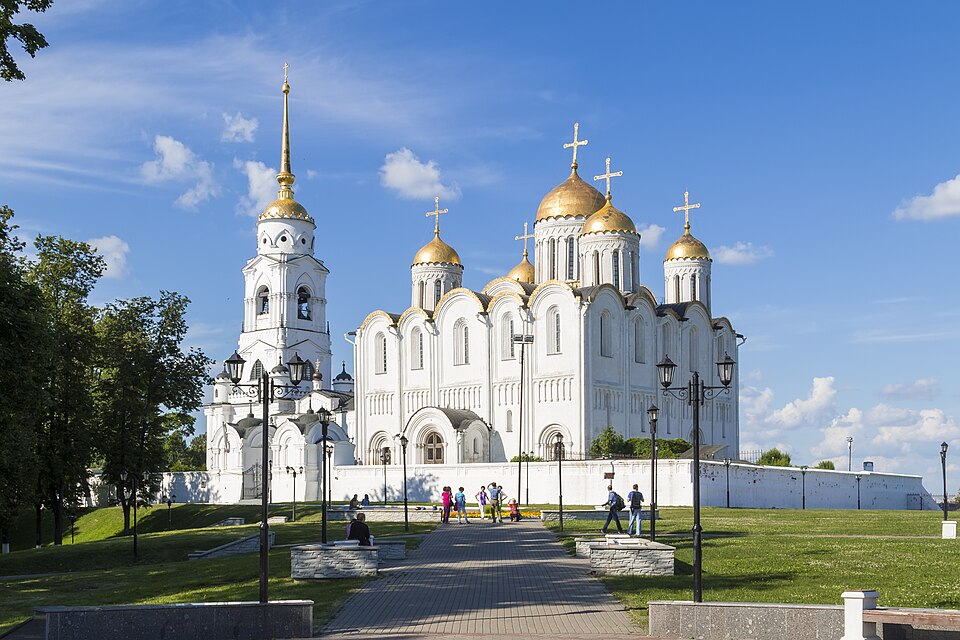
Begin by looking at the Dormition Cathedral from a little distance. Its position high above the Klyazma valley immediately suggests the importance intended for it. This was a building meant to be seen. Pale walls and golden domes presented Vladimir as a major centre of princely and religious authority.
The first cathedral was built in 1158–1160 for Prince Andrey Bogolyubsky. The present building is considerably larger. After a fire in 1185, Vsevolod the Big Nest expanded it by adding new spaces around three sides. Rather than simply replacing the earlier church, the builders incorporated it into the enlarged structure.
Imagine that process and the architecture becomes easier to understand. This is a conversation between two building campaigns separated by only a few decades. The older central part and the surrounding additions form the volume we now perceive as one cathedral. Its history is quite literally contained within it.
A later layer is especially important for art history. In 1408, Andrey Rublev and Daniil Chyorny worked here with their fellow painters. Surviving sections allow us to encounter medieval wall painting in the church for which it was created. Among the celebrated compositions are parts of the Last Judgement in the western area.
Do not assume that every visible painting is by Rublev. The cathedral contains work from different periods, further complicated by later renewal and restoration. Choose a section identified by museum information and spend time with it. A few attentive minutes with a surviving medieval fragment are more rewarding than attaching one famous name to the entire interior.
The cathedral also experienced destruction and fire, including the catastrophe of the Mongol invasion in 1238. It served as a burial place for princes and remained an important shrine. Its history therefore combines artistic achievement with events that cannot be understood solely through architectural beauty.
Worship continues here, while the ancient structure also requires conservation and museum care. If entry is unavailable, there is still much to study outside: proportions, stonework and the relationship with the river valley. Then return to its defining characteristic. Several centuries inhabit this familiar outline, preserved as an accumulated space rather than merely a sequence of dates. Each generation encountered a building already shaped by those who came before it.
Learn more
How can an exterior wall end up inside a building? That happened when the cathedral was expanded in the late twelfth century. New spaces enclosed the older structure, bringing parts of its former façades into the interior. These features now help distinguish construction phases.
Imagine rooms being added around several sides of an ordinary house. A wall that once faced the street may then face an adjoining room. The cathedral's transformation was more complex, but the basic spatial idea is similar.
This is a useful approach to historic buildings generally. A unified appearance outside does not guarantee a simple history within. Wall thicknesses, passages and unexpected decorative fragments may preserve evidence of earlier arrangements. Here, expansion retained a substantial part of the original church and made it the core of a larger whole.