LISTEN TO THE PLACE
A story worth knowing
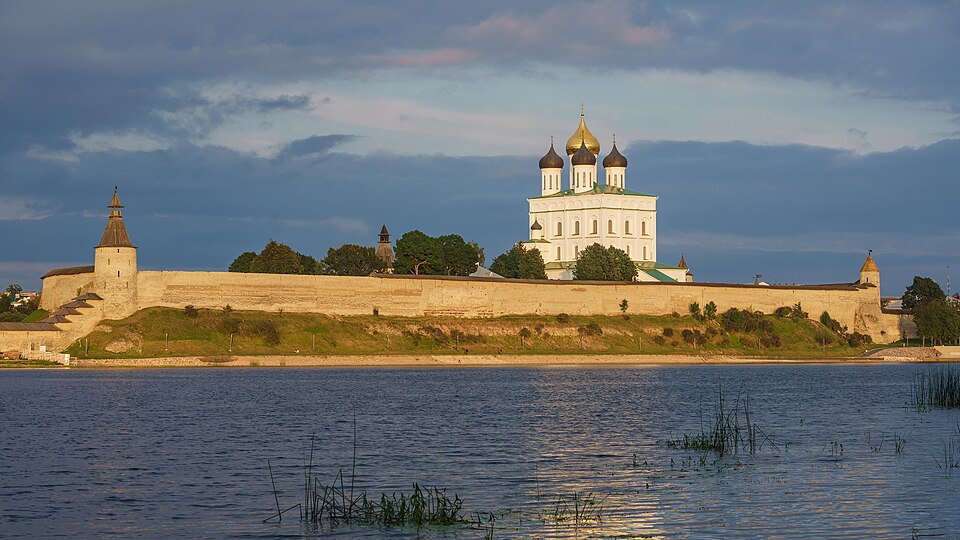
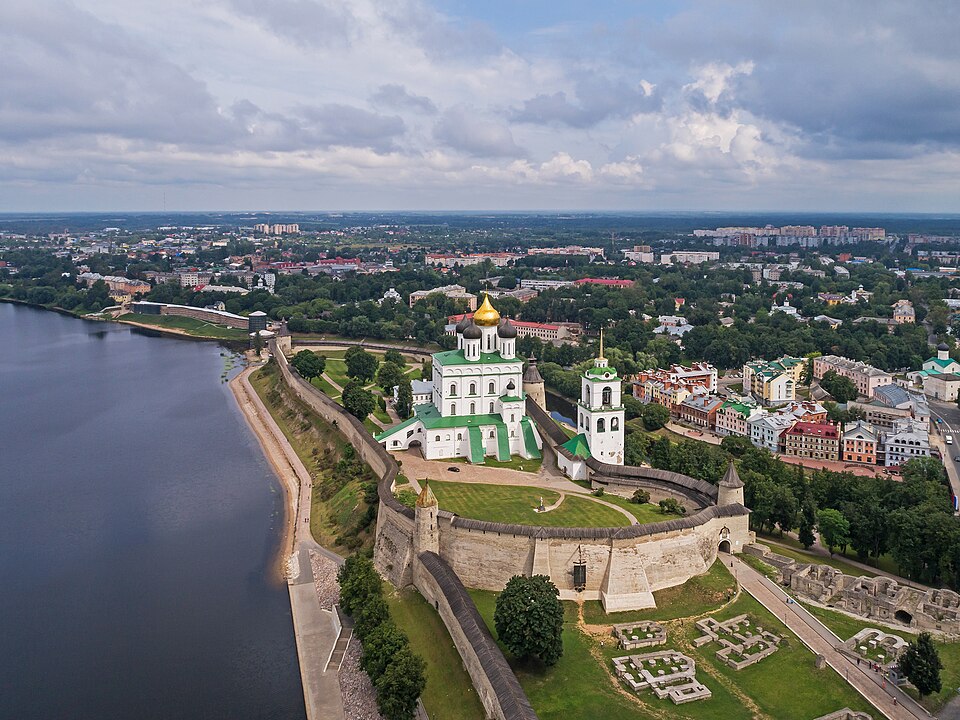
Pskov's kremlin has a short local name: the Krom. Before looking at its towers, look at the rivers. The Pskova joins the Velikaya here, creating a headland that makes an immediately convincing site for a fortress. Water protects two sides. The landward approach needs stronger man-made defences. Geography explains much of the plan before we learn a single tower's name.
The Krom stood at the heart of medieval Pskov, bringing together religious life, civic authority and collective security. Trinity Cathedral rises above the enclosure. The present building was completed in 1699, replacing earlier churches on the site. The age of the sacred place and the age of the cathedral we see are therefore different things. Its great white body remains a landmark even when surrounding buildings conceal the lower walls.
On the approach from the town, notice the southern wall, called the Persi. The name evokes a breast protecting the heart. The entrance also follows a defensive logic. A passage known as a zakhab channels movement between walls. For today's visitor it is a brief transition into another space; for an attacker it meant exposure inside a confined corridor. Imagine the same approach without its peaceful flow of sightseers, and the purpose becomes clear.
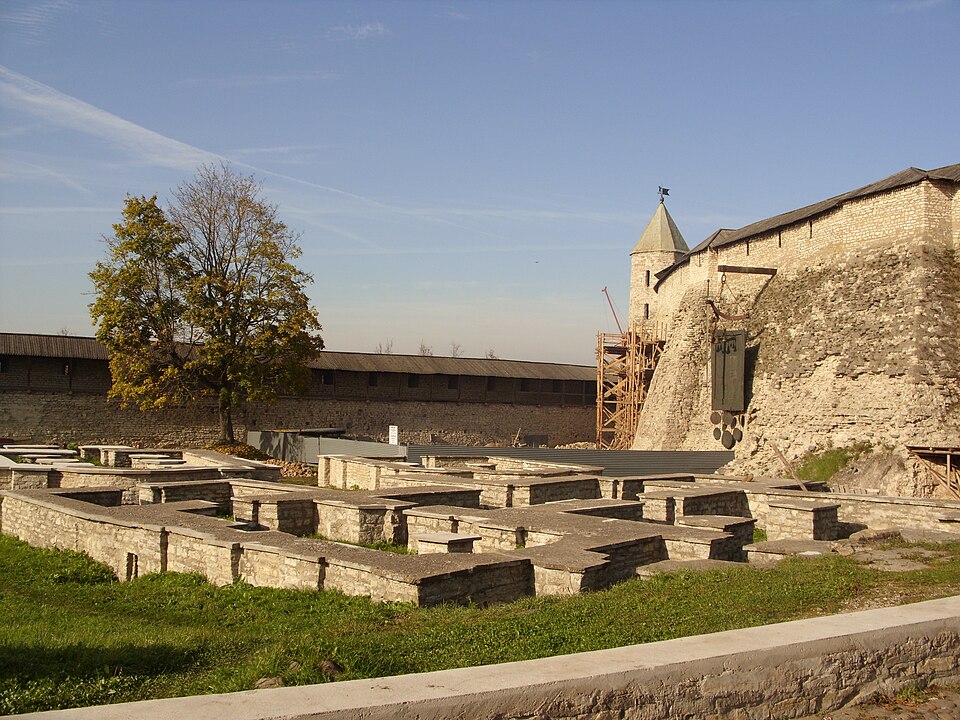
Immediately outside the Krom lies Dovmont's Town. Low stone outlines mark buildings that no longer stand. They may seem less spectacular than the towers, but this is where the ground asks you to use your imagination. Archaeologists uncovered churches, street surfaces and traces of earlier settlement. The displayed foundations help visitors read their arrangement. What looks open now was once a much more densely occupied place.
Extensive restoration during the second half of the twentieth century helped create the coherent silhouette we recognise today. That does not mean every stretch of masonry has survived untouched. Investigation and repair are part of the story too. Nearby, the late-seventeenth-century Prikaz Chambers recall another aspect of the complex: the practical business of administration behind the monumental walls.
Try to fit three things into one view: the low foundations, the defensive wall and the cathedral. They represent three scales of experience: the footprint of an individual building, the boundary of a protected community and a landmark shared by the wider city. Their relationship is what makes this place so rewarding. At the Krom, looking down at the stones can reveal as much as looking up towards the domes.
Learn more
The metal composition on the southern wall includes a sword, a shield and bells. It looks at home beside a medieval fortress, but it is not a surviving medieval fitting. The work was installed in 1972 to commemorate the Battle on the Ice. Its creator was the Pskov artist and blacksmith Vsevolod Smirnov.
Compare the materials. The wall is assembled from many small pieces of stone, while the metal forms communicate through bold silhouettes. One concerns construction and defence; the other concerns the way later generations chose to remember a battle. Seen together, they can easily seem to belong to one period, although centuries separate them.
Noticing that difference adds another layer to a visit. Commemoration has designers, choices and dates of its own. Here you encounter both the history of Pskov and a twentieth-century interpretation of that history, placed directly on the city's ancient defences.