LISTEN TO THE PLACE
A story worth knowing
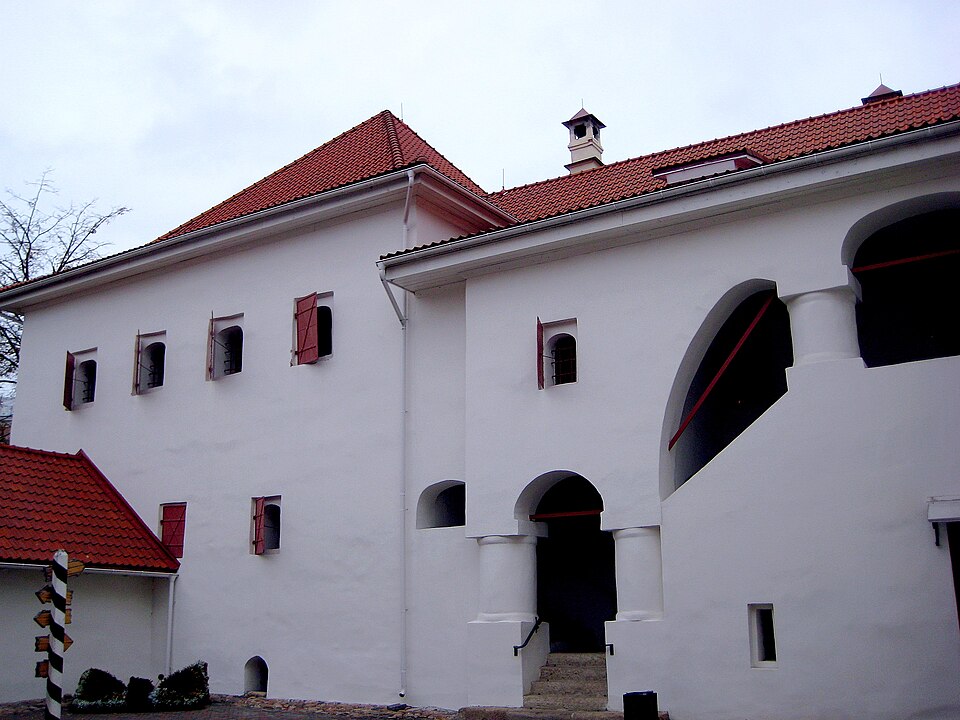
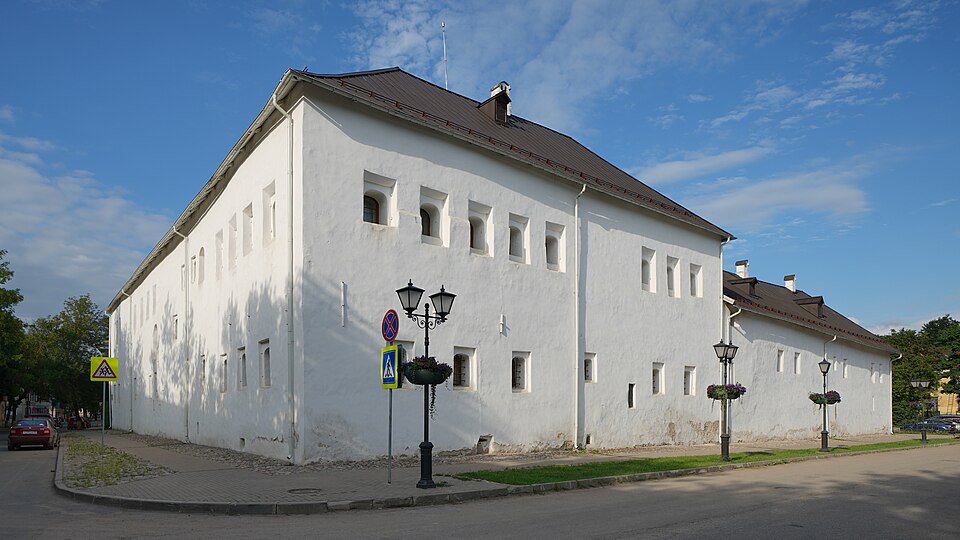
These chambers can easily resemble a small fortress. Pale walls, restrained facades and a strong sense of weight suggest protection. Yet this is the story of a merchant's property rather than a separate military stronghold. The complex is associated with Sergei Pogankin, one of seventeenth-century Pskov's most influential merchants. His surname gave the building its familiar name.
Wealth is expressed here through scale and solidity rather than decorative lightness. A substantial stone house required resources and the ability to organise construction. It also had to accommodate several activities: storing goods, receiving visitors, conducting business and supporting a household. Think of the chambers as part of an extensive working enterprise as well as a residence.
Pskov's trade connected it to places far beyond its walls. Records of Pogankin's business mention flax, hemp, salt and other commodities. Behind those simple names lay transport, accounts, intermediaries and storage. Moving cargo offers a better image of this wealth than a motionless chest of treasure. Prosperity depended on relationships and circulation.
Consider the different functions of lower and upper rooms. Lower storage spaces served practical needs, while more formal rooms occupied higher levels. Stairways within the walls reveal how thick the structure could be. A wall was not merely a boundary between rooms: it could contain a route through the building. That produces a very different experience from a modern house divided by thin partitions.
The use of the chambers changed over time. At the beginning of the twentieth century, they were adapted for a museum. A former merchant complex began holding objects used to study Pskov's past rather than its owner's merchandise. Becoming a museum also involved alterations. Preservation happens through investigation, repairs and new uses, not by removing a building from time altogether.
Before entering, compare the openings with the mass of the facade. If you later see the interiors, recall that outside view. The relationship between restrained appearance and internal arrangement becomes easier to understand. The chambers express a kind of wealth capable of building for the long term. Behind the stone, however, lay a mobile commercial world: people negotiating, taking risks, keeping accounts and sending goods onward. Add that invisible activity to the first impression of solid white walls, and the apparent fortress becomes a much more complex place.
Learn more
A staircase within a wall changes a familiar idea of a house. We usually imagine rooms separated by walls. Here, part of the route occupies the wall itself. Its thickness becomes usable space rather than only a mass of construction material.
For a visitor, that can make scale physically understandable. From outside, the depth of masonry is something to estimate. Inside a passage, it becomes a distance to experience. Such a detail explains the architecture more convincingly than simply calling it massive.
If your visit includes one of these transitions, notice the changes in light and direction. A room approached through a narrow passage feels different from one entered through a wide modern doorway. That does not make every small passage secret: the structure alone proves neither escape routes nor hidden treasure. The real building is unusual enough to hold attention without adding an invented mystery.