LISTEN TO THE PLACE
A story worth knowing
The museum's name may suggest that you have reached the home of explorer Vladimir Arsenyev. This is actually the main building of a large historical museum; his memorial house is at another address. The subject here extends well beyond one biography, although Arsenyev's name offers a useful approach: look closely at the land, its people and the evidence of their lives.
The museum grew from the Society for the Study of the Amur Region, founded in 1884. It opened to visitors in 1890. Early collections brought together archaeology, natural history and cultural material. People working in the region contributed observations and objects, gradually turning individual interests into a shared record.
Arsenyev himself helped build the collections. The museum received his name in 1945, so the connection is more than an honorary title. Exploration and the gathering of knowledge belong to the institution's own history.
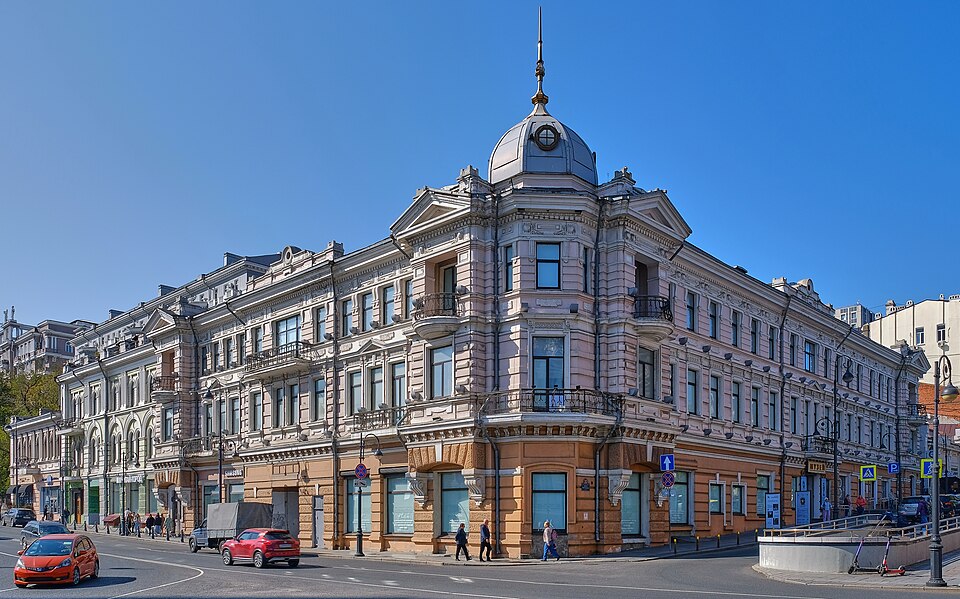
The present building has a separate biography. Constructed in 1902–1903, it was associated with businessman Vasily Babintsev and was not purpose-built as a museum. It belongs to the commercial Vladivostok of the early twentieth century. Even before entering, its scale and position on the street provide evidence of the city's past.
The collections also reach far beyond the history of the Russian port. An important group of objects comes from the twelfth-century burial of the Jurchen prince Esykui. It is a reminder that Primorye's history did not begin with Vladivostok's foundation. Earlier societies had their own political connections, skills and artistic traditions long before the modern city map took shape.
Ethnographic holdings concern Nanai, Udege, Oroch, Ulch, Nivkh and other peoples. Those names should not merge into a single vague category. Different communities have distinct languages, practices and histories. When examining an object, begin with the information about the people and place it comes from before comparing it with its neighbours.
A useful way to approach the museum is to choose one object that makes you curious. Why was it made, how was it used, and how did it enter the collection? Following those questions can take you from a small item to a much wider regional history. The Far East then becomes more than a distant area on a map: it becomes a place of particular lives and experiences that can be distinguished and understood.
Learn more
Two dates appear in the museum's history: 1884 and 1890. The first relates to the founding of the Society for the Study of the Amur Region and the beginnings of its museum work; the second marks opening to the public. The collection did not suddenly appear on opening day.
That distinction reveals work visitors rarely see. Turning an object into a useful museum record involves more than placing it in a case. Its origin, material, purpose and relationship to other evidence all matter.
Ask, “How do we know this?” An inscription may provide one answer, archaeological context another, and a collector's notes a third. An impressive object with no known origin may tell us less than an ordinary item with a carefully documented history. A museum therefore preserves connections between things and their stories, as well as the things themselves.