
LISTEN TO THE PLACE
A story worth knowing
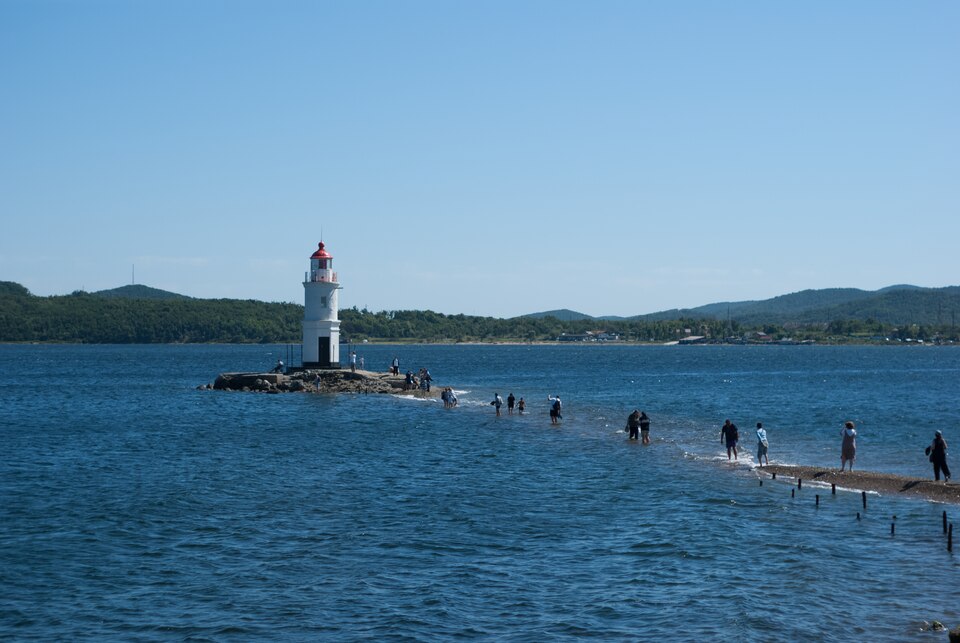
Your eyes reach the lighthouse before your feet do. A narrow strip of stones leads towards a small pale tower with very little to distract from the surrounding sea. In photographs, it can look like the remote edge of the world. In practice, it belongs to the working life of a major port: shipping routes and the need to establish a vessel's position accurately near the coast.
The tower stands on Tokarevskaya Koshka. Here, koshka is a geographical term for a spit, not the everyday Russian word for a cat. The name connects the site with Cape Tokarevsky and the naval officer Mikhail Tokarevsky. Behind that compact place-name lies the work of hydrographic surveying: describing, measuring and mapping a coast so that ships can use it.
The masonry tower dates from the early twentieth century. Its purpose matters more than a single construction date. The lighthouse marks approaches around the Eastern Bosphorus Strait, where maritime routes connect with Vladivostok's bays. For a visitor, it may be the end of a walk. For a mariner, it is one reference within a journey continuing far beyond the photograph.
Try reading the tower as a message rather than a monument. By day, position, shape and colour matter; at night, light carries the signal. A lighthouse needs to stand apart from its background and be recognisable. Its simplicity expresses a practical requirement. Where a mistaken reading of the coast has consequences, unnecessary visual complexity offers little advantage.
The approach is part of the experience. The narrow strip of land brings water close, while wind and sea conditions can alter the same place dramatically. Do not assume that it is always a dry continuation of a city promenade. If water covers the approach, the shore remains a worthwhile viewpoint. You do not need to reach the wall to appreciate how the lighthouse works within the landscape.
Pause and notice movement around the stationary tower: a wave, a passing vessel or changing light. Its value lies partly in remaining a stable reference among those changes. City streets usually orient us through junctions and addresses. Here, orientation becomes a relationship between coast, distance and direction. The visit reveals Vladivostok as a maritime city through an object whose practical task is to help others find their way.
Learn more
A single conspicuous object helps identify a coast. Two markers seen in alignment can define a direction more precisely. This is the principle of a leading line, and nautical descriptions place Tokarevsky Lighthouse within a system involving other navigation marks.
Imagine a near vertical line and a more distant one. When they appear to coincide, you occupy a particular line of sight. Move sideways, and they separate. Simple geometry turns visible objects into a navigational aid. Actual passage planning, of course, depends on current charts and professional information rather than a visitor's audio guide.
For someone standing ashore, the interesting discovery is that the apparently solitary tower is not functionally alone. It belongs to a network of measurements and references. A lighthouse makes a beautiful isolated photograph, but its full meaning depends on relationships that may lie beyond the edges of the image.