LISTEN TO THE PLACE
A story worth knowing
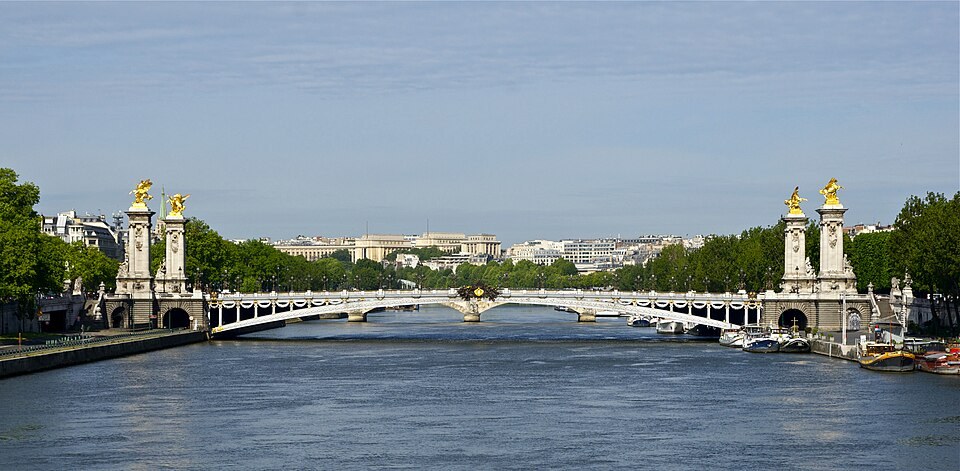
On Pont Alexandre III, it can be difficult to decide where to look: along the river, towards the gilded figures above the pylons, or at the elaborate decoration beside the pavement. This is a crossing conceived as more than an engineering structure. It was intended to take part in a much larger urban performance.
The bridge opened for the Universal Exhibition of 1900. The nearby Grand Palais and Petit Palais belonged to the same transformation, while the crossing connected their surroundings with the direction of Les Invalides. Imagine Paris receiving visitors from around the world: a walk across the Seine became a sequence of carefully staged views, with one impressive feature preparing the way for the next.
The name refers to the Russian emperor Alexander III and the Franco-Russian alliance. The bridge therefore carries a diplomatic meaning beyond its practical role. Relations between states were expressed through architecture and the ornament of public space. It is useful to recognise that historical context without assuming that late nineteenth-century politics map directly onto relationships between countries today.
Beneath the rich decoration lies a demanding engineering solution. The low metal arch helps preserve views along the river. A much taller, heavier structure would interrupt the surrounding perspectives. Here, engineering supports the larger architectural intention: the bridge must be impressive in its own right while allowing the city beyond it to remain visible.
Its ornaments are arranged for different distances. The tall pylons establish landmarks in a broad view; lamps and sculptural groups reward the person crossing on foot. From far away, you read the silhouette. At close range, details take over. This double scale makes the bridge particularly satisfying as a walking stop, rather than merely something to photograph from another bank.
Pause beside the railing without obstructing other pedestrians and look along the Seine. Then turn towards one end of the crossing. Notice how the low bridge line, the tall accents and the surrounding buildings form a connected composition. The attraction is not simply the amount of ornament, but the way each element plays a role in the whole.
Pont Alexandre III joins technical purpose with ceremonial display. Engineering makes it possible to cross the river with a clear span and open views; sculpture and architecture turn an ordinary journey between banks into a memorable occasion. That partnership is the main story here, and it remains visible even if you do not identify every figure or emblem decorating the bridge.
Learn more
Universal exhibitions did not leave Paris only temporary pavilions. They sometimes prompted the transformation of an entire district and produced structures intended to last. Consider this bridge together with the two exhibition palaces nearby. You do not need to enter every building to understand the ensemble: its urban composition is clear from outside. Visiting exhibitions is a separate activity, requiring additional time and whatever admission arrangements are currently in force.