LISTEN TO THE PLACE
A story worth knowing
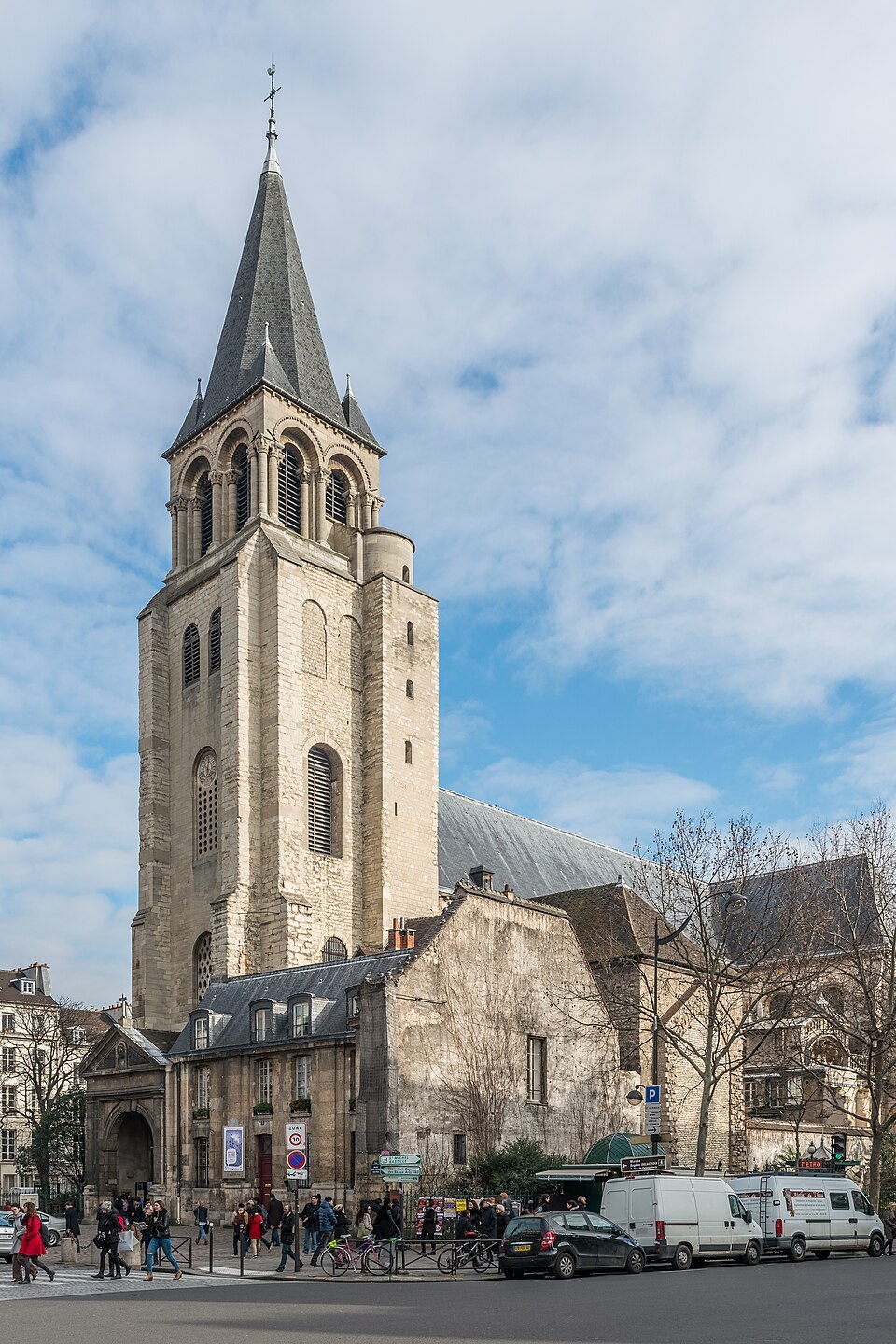
Saint-Germain-des-Prés is often associated today with cafés, literature and the intellectual life of the Left Bank. The neighbourhood’s name, however, leads back to a much older story: a major abbey, of which the church survives. Its tower recalls a world long before the celebrated cafés.
The abbey was founded in the sixth century. Buildings were rebuilt, damaged and renewed over the following centuries, so the entire visible church should not be treated as dating from that first foundation. Important medieval fabric survives, but the age of an institution and the age of a particular wall are not necessarily the same.
The words “des Prés” mean “of the meadows”. Standing in densely built modern Paris, that can seem difficult to imagine. The name preserves an earlier geography, when the abbey’s surroundings looked very different from these busy streets. The expanding city absorbed the landscape, while language kept a trace of it.
An abbey was more than a place of prayer. Such institutions held land, preserved books, maintained networks and influenced the lives of surrounding communities. The disappearance of much of this complex following the revolutionary period therefore represented the loss of an institutional world, not merely a few old buildings. The surviving church is only part of what once existed here.
Look at its comparatively restrained silhouette. It differs from the more theatrical monumentality of later periods. Pay attention to the tower’s proportions, the smaller openings and the impression of substantial wall surfaces. Historical importance does not have to express itself through endless decoration. Sometimes it is present in the persistence of an old volume within a much later city.
During your walk, compare the neighbourhood’s monastic identity with its more recent literary and café culture. They do not cancel each other out. They show how a place can change its cultural role while retaining traces of previous lives. Parisian memory often works in this layered way: a new reputation is established over an older foundation.
If the church is open, enter with respect for worship and the people using it. From outside, you can still try a simple act of imagination. Temporarily set aside the traffic and shopfronts, and consider the word “meadows”. It reveals how far the modern district has travelled from the landscape that gave it its name.
That distance between name and present appearance is not a historical error. It is one of the ways the city carries its past forward, even when the original surroundings have vanished.
Learn more
Historic place names can function like small archaeological finds. Words meaning meadows, gates, markets or monasteries may remain after the original feature has disappeared. Saint-Germain-des-Prés is a useful reminder to listen for these traces while walking. A name provides a clue rather than a complete reconstruction, however. The precise position of former boundaries and buildings should be checked on historical plans, not filled in entirely by imagination.