LISTEN TO THE PLACE
A story worth knowing
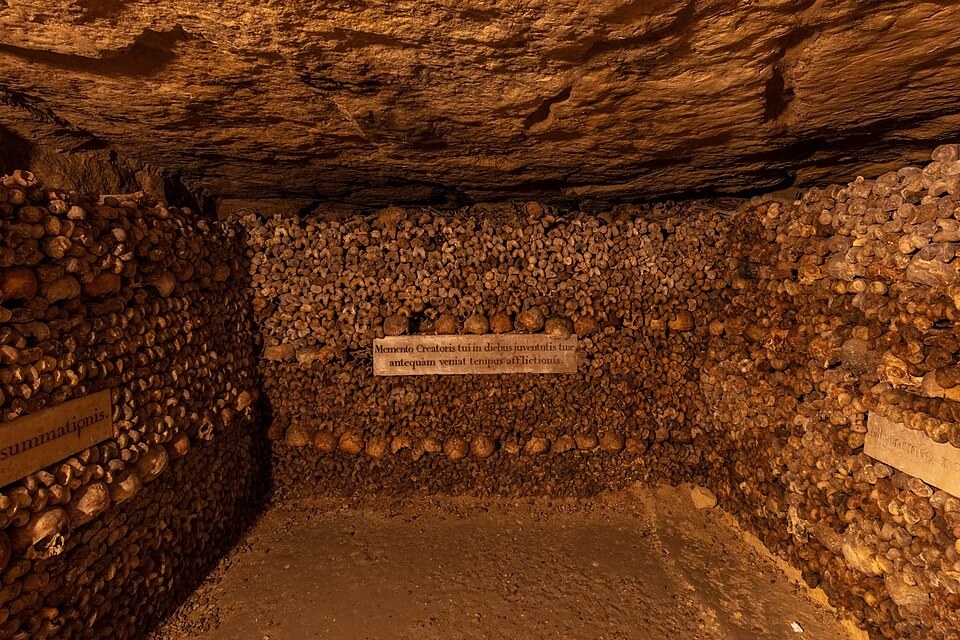
Beneath the ordinary streets of Paris lies another environment: former stone quarries and engineered underground galleries. The famous Catacombs occupy only a small part of that system. They are a municipal ossuary, a place where human remains were transferred from earlier cemeteries.
The story did not begin with a secret cult or a romantic underground society. Paris was growing, and burial grounds within the city had become overcrowded. In the late eighteenth century, a practical public-health and administrative solution was required. Remains were moved into disused quarry workings, where stone had previously been extracted for construction. Two consequences of urban life—the need for building material and the need for burial space—met underground.
Stone from beneath Paris helped create the city above, but the resulting voids also posed risks of collapse. This is therefore a history of inspection, reinforcement and control as much as excavation. The popular image of an endless, freely accessible labyrinth leaves out the extensive work required to support streets and buildings.
Inside the ossuary, bones are arranged in recognisable compositions. Their visible order resulted from the organisation of the site and its presentation to visitors. It does not preserve the original position of individuals in their graves. These are transferred remains, and that distinction matters. The setting may be powerful, but real deceased people should not be reduced to props in a frightening story.
The word “catacombs” is often loosely applied to the entire underground network. For a visitor, that is a misleading shortcut. The official museum route and closed quarry or technical spaces are not the same thing. This guide refers only to authorised access; it does not suggest searching for unofficial entrances or exploring underground passages independently.
Following an update to the site, the Catacombs reopened to visitors in April 2026. You should still check current access, booking arrangements and route restrictions before planning a visit. There are stairs and particular underground conditions, so a brief stop outside should not be mistaken for a simple, universally accessible indoor walk.
Rather than asking only how frightening the experience might be, consider a different question: how does a large city manage the consequences of its own growth? The Catacombs offer a physical answer. They connect the stone that built Paris, the spaces left by extraction and the relocation of generations of its inhabitants. Much of a city’s essential history is invisible from the pavement; here, that hidden history becomes unusually tangible.
Learn more
An ossuary and a cemetery are not exact synonyms. An ossuary holds remains that have often been transferred from their original burial places. This explains why the Paris Catacombs do not resemble rows of individual graves. Follow the museum’s rules and do not touch or move anything. However striking an arrangement may look, it remains part of a place of human remembrance, not a collection of objects available as souvenirs.