LISTEN TO THE PLACE
A story worth knowing
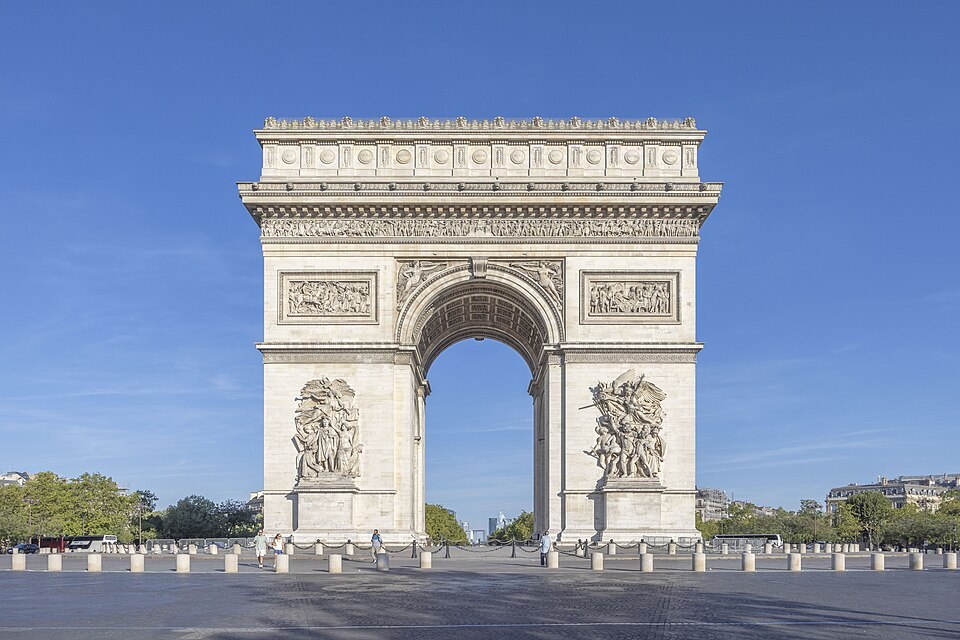
Around the Arc de Triomphe, Paris seems to radiate outward. Broad avenues converge on one centre, and the massive stone structure holds the composition together. The square's former name, Étoile, meaning star, becomes clear if you imagine the surrounding streets from above.
The arch was commissioned under Napoleon early in the nineteenth century, but completed after his rule. A ruler's intention and a monument's lifetime do not necessarily coincide. A structure dedicated to military glory became a witness to several political periods, each capable of using its image differently.
Reliefs and inscriptions refer to campaigns, commanders and victories. From a distance, the monument appears to be strict geometry. Up close, the stone becomes a narrative. Figures are deliberately large and gestures emphatic. Sculpture in an open urban setting must remain effective when viewers stand far away.
Beneath the vault is a memorial with a different emotional register: the Tomb of the Unknown Soldier from the First World War. Instead of celebrating a famous commander's name, it honours an unidentified person. This changes the experience of the stop. Triumph and mourning occupy the same place, bringing an individual human scale into a grand account of warfare.
Do not try to cross the traffic circle directly. Use designated pedestrian approaches, and check arrangements separately if you want to climb the monument. Even from outside, you can see how the nearby stone structure connects with the long perspective of the Champs-Élysées. It is both an object in front of you and an orientation point for an entire district.
For a moment, set aside the movement of vehicles. Imagine seeing only the vault, the sky within it and the avenue extending into the distance. An arch is an unusual memorial: the opening matters as much as the stone. Through that empty space, you continue reading the city. Architecture makes a direction of travel ceremonial, turning an ordinary urban perspective into a place of memory.
Learn more
The words triumphal arch suggest a story entirely about victory. The Unknown Soldier introduces another question: how should people remember those whose names have been lost? Here, anonymity is the memorial's meaning rather than an information gap. One person represents many unknown lives. Near the tomb and flame, a pause and a respectful distance are more appropriate than the pace of the busy square surrounding them.