LISTEN TO THE PLACE
A story worth knowing
The most important landmark at Place de la Bastille is no longer standing. The famous fortress was dismantled after the events of 1789. This makes the square an unusual stop: the historical importance of the site greatly exceeds the visible remains of the building that gave it its name.
The Bastille began as a fortification and later served as a state prison. By the late eighteenth century, it had acquired a powerful association with arbitrary royal authority. Its storming on 14 July 1789 became one of the defining images of the French Revolution. The significance of that event cannot be measured simply by the number of prisoners released. The fall of the fortress represented a change in the structure of power itself.
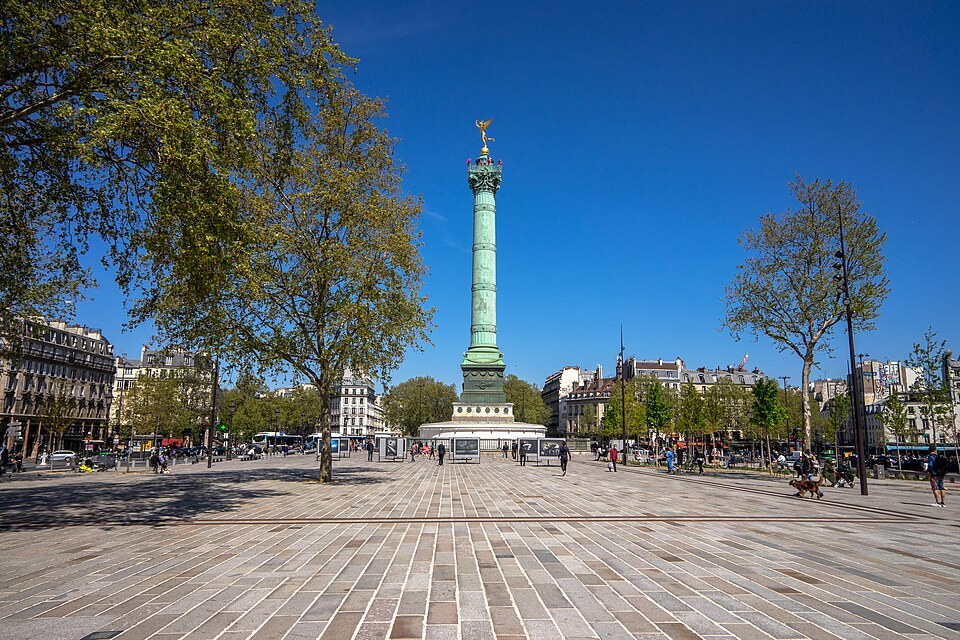
The tall monument now standing in the square is the July Column. It often causes confusion: it commemorates the July Revolution of 1830, not the storming of the Bastille in 1789. Those decades matter. French political history did not become calm and straightforward after the first revolution. New conflicts and changes of regime continued to transform the city. The column belongs to one of those later chapters.
The square’s name brings several periods together without making them a single event. The vanished prison, the column and the modern Opéra Bastille arose from different purposes. The opera house occupies a site previously used by a railway station. Within one urban junction, defence, confinement, transport, political memory and performance have succeeded one another.
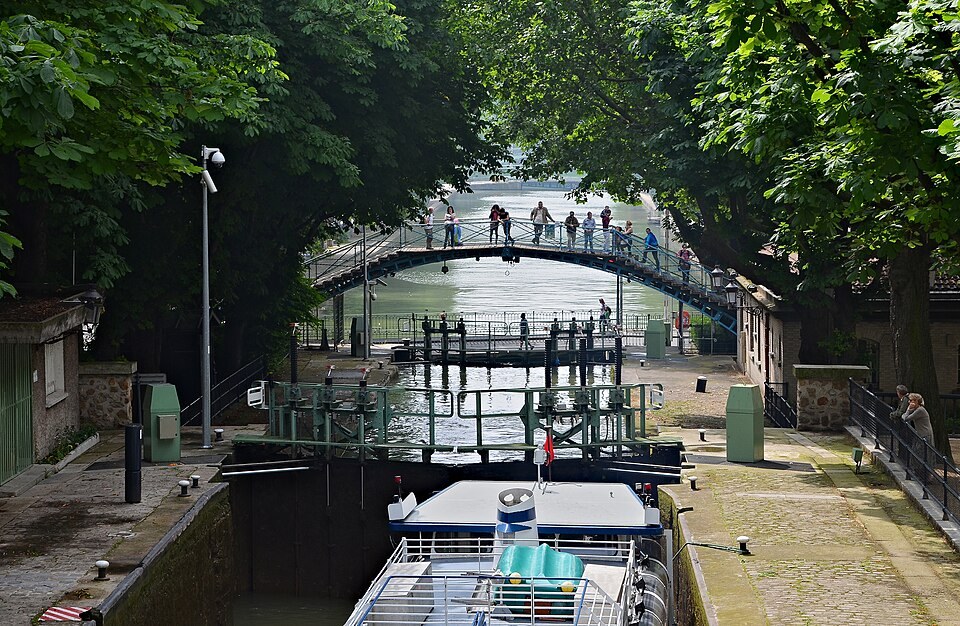
Water adds another, less obvious layer. The Canal Saint-Martin system passes through this area, connecting it with the Paris of freight, ports and urban engineering. Looking only at the top of the column can make that relationship easy to miss. The square is not an isolated monument setting, but a meeting point for several kinds of movement.
As you walk, imagine a change of spatial experience rather than trying to reconstruct every wall of the old fortress. A massive enclosure once dominated the site. Today, it is open and full of circulation. The physical building has gone, yet the name still shapes how people understand the location.
Bastille remains associated with public gatherings and political expression because it continues to function as a symbol. Sometimes demolition strengthens a building’s presence in collective memory rather than ending it. Here, absence can be more historically powerful than a surviving façade. The square asks us to look beyond what is directly in front of our eyes and recognise the events that still give the place its meaning.
Learn more
The July Column should not be treated as a direct visual caption for 14 July 1789. That shortcut may work on a postcard, but it mixes two revolutions. Paris contains many monuments installed long after an event, or dedicated to a different episode on an already famous site. A useful travelling habit is to distinguish the place name, the monument’s dedication and its installation date. They do not always tell the same story.