LISTEN TO THE PLACE
A story worth knowing
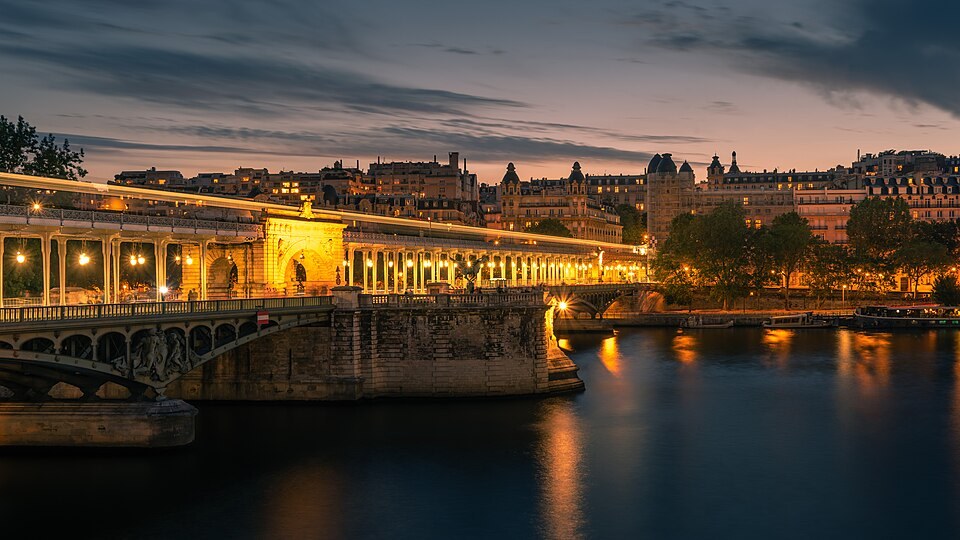
At Pont de Bir-Hakeim, Paris moves on two levels at once. Métro trains pass overhead, pedestrians and road traffic use the level below, and views open towards the Seine and the Eiffel Tower. This is a particularly clear example of urban beauty emerging from a structure itself rather than only from ornament added to it.
The bridge was built in the early twentieth century and was originally named Passy, after the nearby district. It was later renamed to commemorate the 1942 Battle of Bir Hakeim in North Africa, where Free French forces fought. The present name dates from 1948. Its title therefore records military remembrance, while the structure tells an earlier story about the expansion of urban transport.
The defining feature is the two-level arrangement. The Métro runs above the lower crossing, and the supports form a long repeated perspective. Looking along them, separate columns combine into an almost endless rhythm. Move a few steps sideways and the orderly image breaks into individual parts. This strong relationship with viewpoint helps explain the bridge’s appeal to photographers.
Yet the structure does not exist simply to provide a beautiful frame. It performs everyday work, carrying people over the river and supporting passing trains. The sound of an approaching Métro makes that function immediately present. Unlike a quiet commemorative monument, the bridge’s activity can be heard and felt as well as seen.
The Eiffel Tower adds another visual relationship. From here, it appears within an active setting of water, supports and movement rather than as an isolated postcard object. Changing the foreground can give the familiar silhouette a different character. Find your view only from pedestrian space, without stepping into traffic or obstructing other users.
Try first looking along the repeated supports, then moving to a permitted position with a more open river view. Compare the enclosed perspective of the structure with the broad space of the Seine. Their proximity is central to the bridge’s effect.
Bir-Hakeim deserves attention as more than a convenient place to photograph the tower. It brings engineering, historical memory and routine movement into one working ensemble. The layers do not replace each other: the commemorative name remains, the trains continue, and visitors discover new visual arrangements among the supports.
Here, Paris is especially clearly a moving system rather than a museum setting. The attraction lies partly in that continuing use. A passing train is not necessarily an interruption to the view; it can be the moment that makes the bridge’s purpose most understandable.
Learn more
Photographs here often use the converging lines of the supports. They create depth even though the structural elements repeat at regular intervals. This is an ordinary effect of perspective made especially strong by repetition. Compare a central view with a slightly offset position without blocking the route. The difference demonstrates how much an architectural image depends on the observer’s location, even when nothing in the structure itself has changed.