LISTEN TO THE PLACE
A story worth knowing
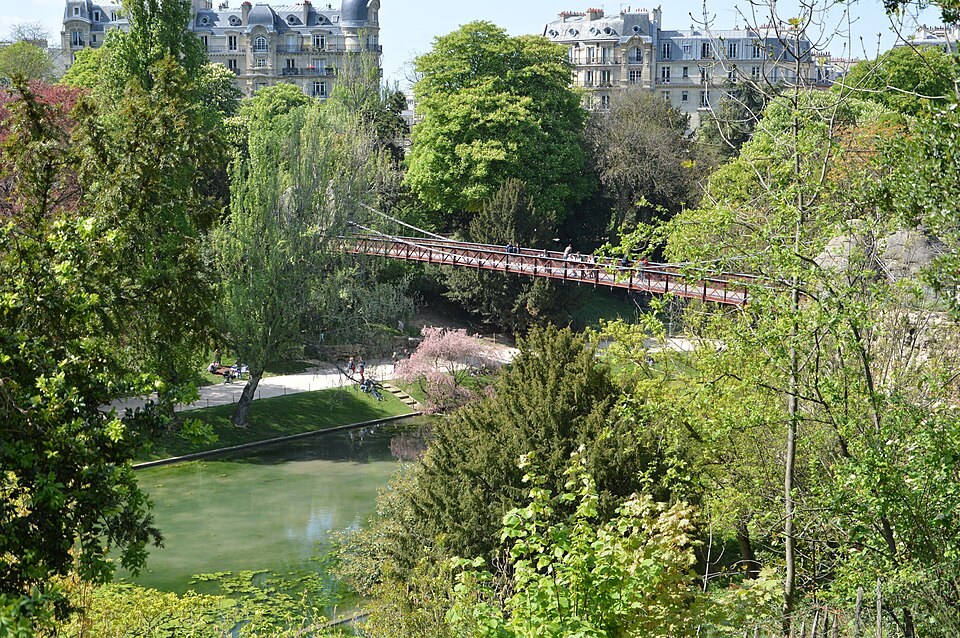
The Buttes-Chaumont can surprise anyone accustomed to the flatter formal gardens of central Paris. Here are steep slopes, a lake, a cliff and a small temple above it. The landscape feels almost theatrically wild. That impression is appropriate: this is not an untouched fragment of nature that happened to survive, but a boldly designed urban park.
Before the park existed, the site was associated with quarrying and demanding practical uses. During the major nineteenth-century transformation of Paris, new green spaces were created alongside new streets. Under the direction of Adolphe Alphand, this difficult terrain became a public place of recreation. The park opened in 1867.
Rather than erasing every change of level, the design exploited the drama of the ground. Height, slopes and water became the basis of the experience. A walker repeatedly changes viewpoint, looking down from above, then standing below, then seeing the same feature through trees. The visit unfolds as a sequence of scenes rather than a straight procession along one axis.
The little structure above the cliff is known as the Temple of the Sibyl. It is a garden building using an ancient architectural image, not a surviving sanctuary from Roman Paris. Such structures were intended to create atmosphere, frame a view and suggest cultural associations. They allowed the imagination to travel beyond the city even while the visitor remained in a public park.
Compare this setting with the formal gardens nearer the centre. There, order is expressed through straight lines and symmetry. Here, winding routes and surprise play a larger role. It would be too simple to call one artificial and the other natural. Both are carefully designed. One makes its geometry obvious; the other makes apparent naturalness part of the artistic effect.
Follow the available paths and current signs as you explore. Slopes, bridges and other features require monitoring and maintenance, so familiar routes may sometimes be closed. There is no need to reach every viewpoint regardless of conditions. The park’s principal story is already visible without crossing a barrier.
That story is the transformation of a difficult working landscape into a shared place of leisure. The Buttes-Chaumont shows that a city does not only consume green space. It can also create new opportunities for rest and pleasure on land once thought unsuitable for a pleasant walk. The result is neither wilderness nor a simple ornamental garden, but a carefully constructed encounter between urban ambition, inherited terrain and the desire for a different kind of outdoor experience.
Learn more
A “landscape” park is not a park without a plan. A path that appears to follow a slope casually can be as carefully calculated as a straight avenue. At the Buttes-Chaumont, changing viewpoints make this clear: the same cliff becomes the central feature, then disappears behind planting. The designer controls not only the shape of the ground, but also the sequence in which a walker encounters it.