LISTEN TO THE PLACE
A story worth knowing
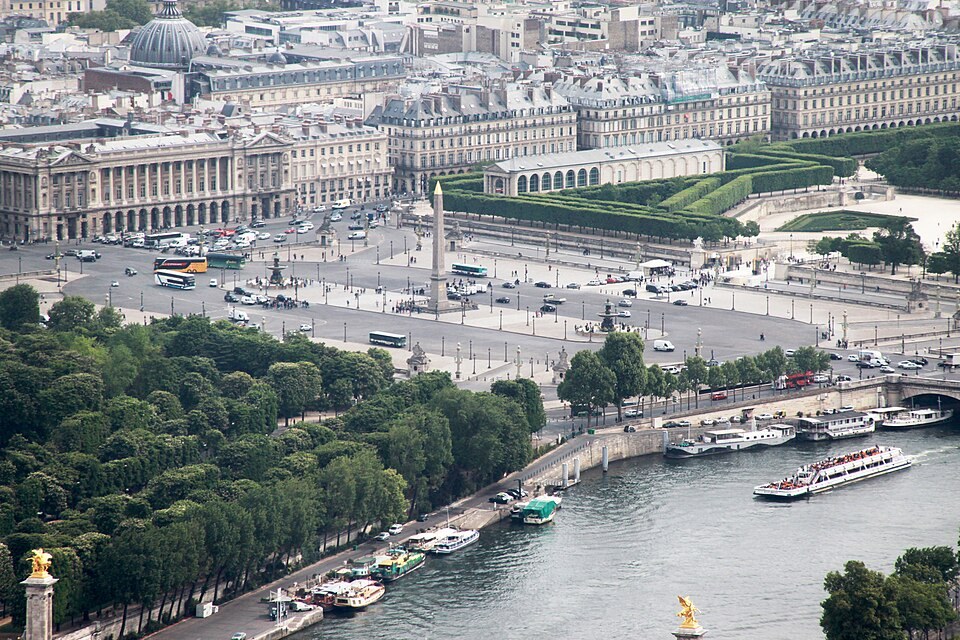
Place de la Concorde appears designed for a ceremonial view: fountains, statues, an obelisk and long perspectives across the city. Yet its peaceful name conceals one of the most turbulent histories in Paris. Few places show more clearly how a city tries to reinterpret its own past.
The square was created in the eighteenth century to honour Louis XV. An equestrian statue of the king occupied its centre. Monarchy was expressed not only through that image, but through the spacious, orderly composition around it. The design presented a world arranged around royal authority. Its open relationship with the Seine and its position between the Tuileries and the Champs-Élysées also made it a major part of the urban landscape.
During the French Revolution, the royal statue was removed. The square acquired a new name and a radically different purpose. A guillotine was installed here. Louis XVI and Marie Antoinette were executed on this site in 1793, along with many other victims during the revolutionary period. A setting conceived for royal celebration became a stage for political violence. The same space could communicate opposing ideas about power.
The later name “Concorde” expressed a hope for reconciliation. Renaming did not erase what had happened. The memory remains attached to the site even when no visible execution apparatus confronts the visitor. A place does not need to look sombre to carry a difficult past.
The Luxor Obelisk introduced a completely different timescale. This ancient Egyptian monument was erected here in 1836. It is far older than the surrounding Parisian cityscape and does not celebrate a French ruler. Look at the carved signs on its surface and the treatment of its pedestal. It is not merely a decorative needle, but a historic object transported from another setting, with a life that began far from the Seine.
The square’s surrounding features help frame that object within a grand civic composition. Yet the most revealing way to understand the place is to keep its different histories together rather than reducing it to a single symbol. Royal ceremony, revolutionary violence and a later desire for unity all belong to its story.
Stay on the pedestrian areas while looking around; the broad open views can make distances and traffic movements deceptive. From a safe position, compare the directions towards the garden, the avenue and the river. Place de la Concorde is a junction of urban perspectives, but it is also a meeting point of competing memories.
Learn more
The obelisk is not a memorial to the revolutionary executions. Its installation belongs to a different period and political context. The history of a site and the history of an object placed on it are often distinct. Ask two separate questions: what happened here, and why was this particular monument installed here later? The square then becomes a layered urban document rather than a simple illustration of one event.