LISTEN TO THE PLACE
A story worth knowing
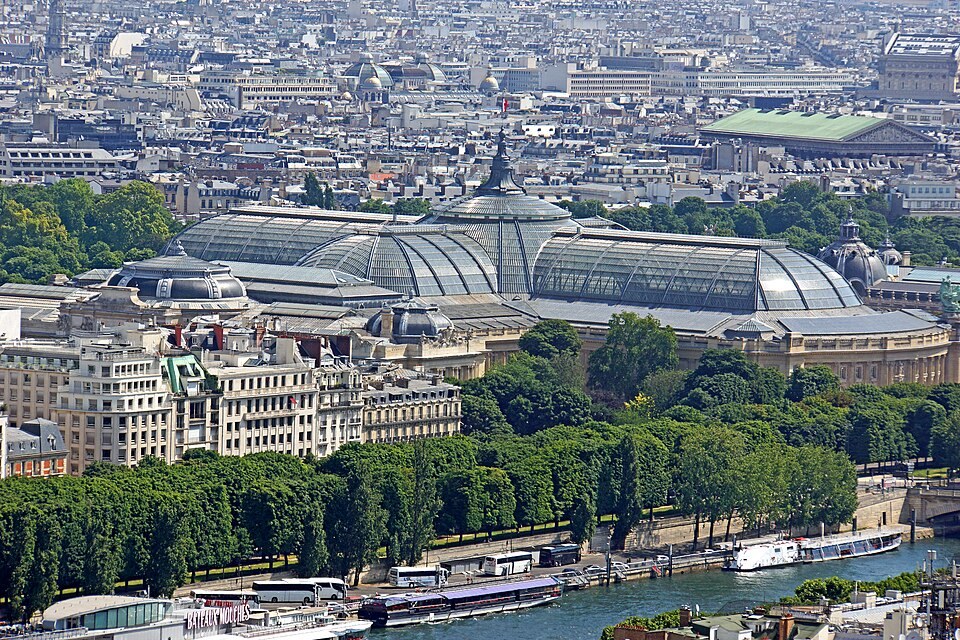
The Grand Palais presents two faces of the same age. Outside are ceremonial stone façades, sculpture and classical forms. Above and behind them lies a vast glass roof supported by metalwork. Paris at the turn of the twentieth century wanted to appear both an heir to a great artistic tradition and a city confidently displaying modern technology.
The building was created for the Universal Exhibition of 1900. The nearby Petit Palais and Pont Alexandre III belonged to the same urban transformation. Visitors were meant to move between impressive settings, experiencing the capital as a demonstration of art, engineering and national prestige. The word “palace” does not indicate a royal residence here. It conveys the scale and dignity of a major public building.
The Grand Palais was intended for large artistic events, but its considerable internal volume allowed uses beyond a conventional picture gallery. An exhibition hall needs to accommodate changing contents. Unlike a room designed around one fixed activity, such a structure anticipates different programmes and ways of arranging an audience.
Look at the relationship between weight and lightness. Stone communicates permanence; glass promises air and illumination. Metal construction makes it possible to cover substantial spaces without filling them with massive dividing walls. In this respect, the palace belongs to the wider world of industrial-age architecture, even though its decorated exterior may appear closer to a classical monument.
Throughout its life, the building has changed and undergone major renewal. That is unavoidable for a structure expected to preserve a historic appearance while also accommodating large crowds, technical equipment and new kinds of event. Today’s Grand Palais is not a pavilion frozen at the moment of one exhibition. It remains a working cultural space with continuing practical demands.
For your walk, distinguish between viewing the architecture and attending a particular exhibition or event. Programmes, entrances and accessible areas depend on current arrangements. The presence of an open public approach should not be taken as a promise that every interior space is available to visit.
From outside, find a position where the glass roof can be seen rising above the stone, then compare the building with the Petit Palais opposite. A single ensemble offers different scales and experiences. The contrast is part of its interest.
The Grand Palais demonstrates how a temporary international celebration could produce a lasting urban image. The exhibition ended, but the architecture continued to shape Paris. More than a century later, the balance between ceremonial tradition and technical ambition remains clearly readable in the building itself.
Learn more
The glass roof is more than an attractive silhouette. For an exhibition building, it historically offered natural light across a very large area. Light also needs to be managed: its strength, direction and associated heat affect conditions inside. Conserving such a monument is therefore not only about restoring sculpture and stone. A complex technical system must be maintained so that a historic structure can continue to support contemporary events.