LISTEN TO THE PLACE
A story worth knowing
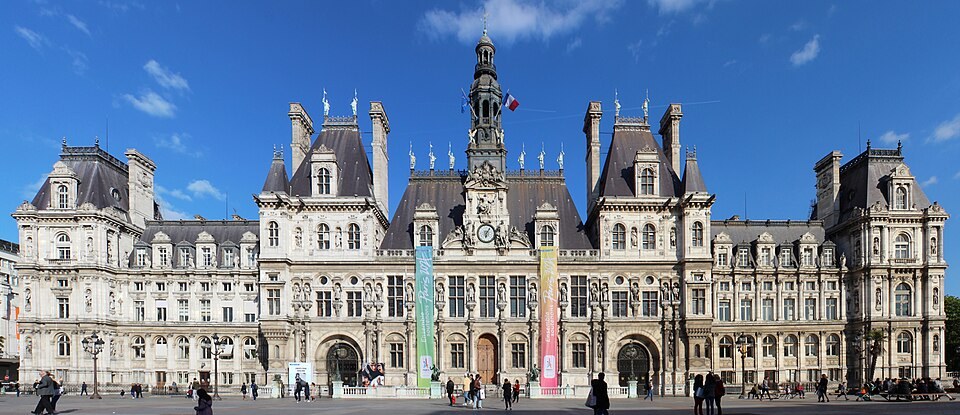
The French name “Hôtel de Ville” can confuse a visitor looking for somewhere to stay. This is not a hotel, but the city hall. Its elaborate façade resembles a palace, yet it represents Paris as a civic community rather than a royal court.
Municipal authority has been associated with this site since the fourteenth century. A later building with a Renaissance appearance was expanded over time. The central position beside the Seine also made the surrounding square an important setting for trade, gatherings and public events. The city’s history unfolded both inside the rooms and outside the entrance, among the people who assembled here.
The present façade should not be understood as an untouched survival from the sixteenth century. In 1871, during the final days of the Paris Commune, the city hall burned. The municipal archives kept inside were also lost. The destruction affected not only architecture but the documents through which a city remembered its own life. Reconstruction followed, preserving the historic language of the exterior while substantially changing the interior arrangements.
What stands before us is therefore both an image of continuity and a nineteenth-century rebuilding. This dual identity is common in Paris. A familiar “old” appearance can be the deliberate choice of a later generation, made because restoring a recognisable civic image matters even when the earlier fabric cannot be saved.
Look at the many figures, niches and decorative details across the frontage. They are not simply an accumulation of ornament. A major public building uses sculpture to present a vision of the city’s history and dignity. From a distance, the individual elements merge into a ceremonial silhouette. At closer range, the façade becomes something like a collection of portraits and symbols.
The square in front can change considerably according to events, temporary installations and the city’s programme. Do not expect it always to resemble a familiar photograph. Its ability to take on new uses is part of what keeps it a functioning public place rather than a fixed stage set.
Pause and compare the stable architectural image with the changing life before it. That contrast expresses much of the purpose of a city hall. Paris preserves memories and institutional continuity, but it also continues to organise, debate, celebrate and respond to current events. The same walls can frame very different moments.
An exterior visit is enough to appreciate this relationship. Entry to the working municipal building is a separate matter, governed by current visiting arrangements rather than by the openness of the square outside.
Learn more
In French architectural history, “hôtel” does not always mean a hotel. An hôtel particulier is a substantial private urban residence, while an Hôtel de Ville is a city hall. This distinction is useful when walking through Paris: a name containing the word may belong to a museum, an institution or a historic mansion. Read the full title and context rather than assuming that the building offers accommodation.