LISTEN TO THE PLACE
A story worth knowing
The name Jardin des Plantes, or “Garden of Plants”, can sound almost too obvious. What garden does not contain plants? Here, however, the name points to a particular purpose. This is not simply a green pause within the city, but a place where nature is studied, described, compared and presented to the public.
Its history began in the seventeenth century with a royal garden of medicinal plants. Such collections were closely connected with medicine. Using a plant required the ability to distinguish it from similar species, understand how it grew and pass that knowledge to students. Beds and collections therefore became teaching tools, and moving among them could be part of scientific work.
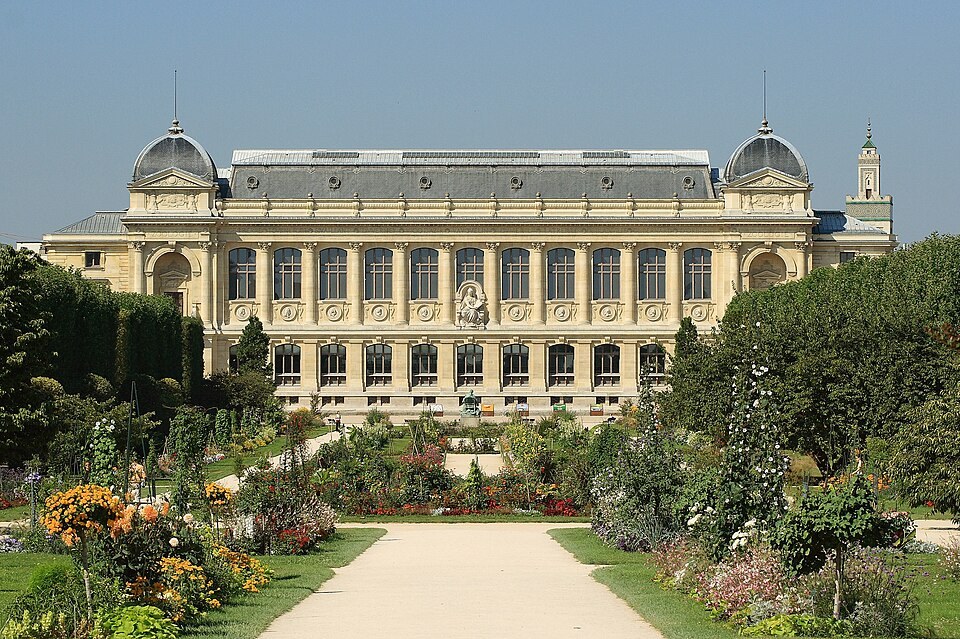
The institution’s purpose expanded over time. The garden is associated with the National Museum of Natural History, and a whole scientific district developed around it: galleries, greenhouses, collections and research facilities. Nature is approached here not as one attractive scene, but as a diversity of living forms and relationships. The large gallery building is only one element in that wider world.
Notice how a label changes your way of seeing a plant. An unfamiliar shrub stops being merely a patch of green. It has a name, an origin and a place within a system of knowledge. Scientific understanding also changes, of course. A historic botanical garden tells us about the natural world and about the evolving ways people have tried to classify it.
You do not need specialist training to enjoy the setting. Patterns of planting, seasonal flowers, substantial trees and greenhouse forms invite an ordinary walk. The scientific role does not cancel the pleasure of being here. It adds another possibility: asking why particular plants have been brought together and what comparison might reveal.
Do not assume that the entire complex is one museum with a single admission system. Garden areas, galleries, greenhouses and other facilities can have different tickets and opening hours. For this stop, an accessible path and a few carefully observed plants are enough.
Try moving from the general impression of greenery to a specific difference: the outline of a leaf, the texture of a trunk or the way branches divide. That change of attention is at the heart of the place. The Jardin des Plantes suggests that scientific curiosity begins not necessarily with an elaborate instrument, but with noticing two apparently similar things and asking how they differ. It is a useful habit to carry into the rest of your walk.
Learn more
Botanical names help people from different countries refer to the same species even when everyday names vary. That is why Latin often appears on labels. A garden label is not medical advice, however: a plant’s historical use in medicine does not make it safe to consume independently. The visitor’s role is to observe and learn, leaving the living collection intact rather than picking or sampling any part of it.