LISTEN TO THE PLACE
A story worth knowing
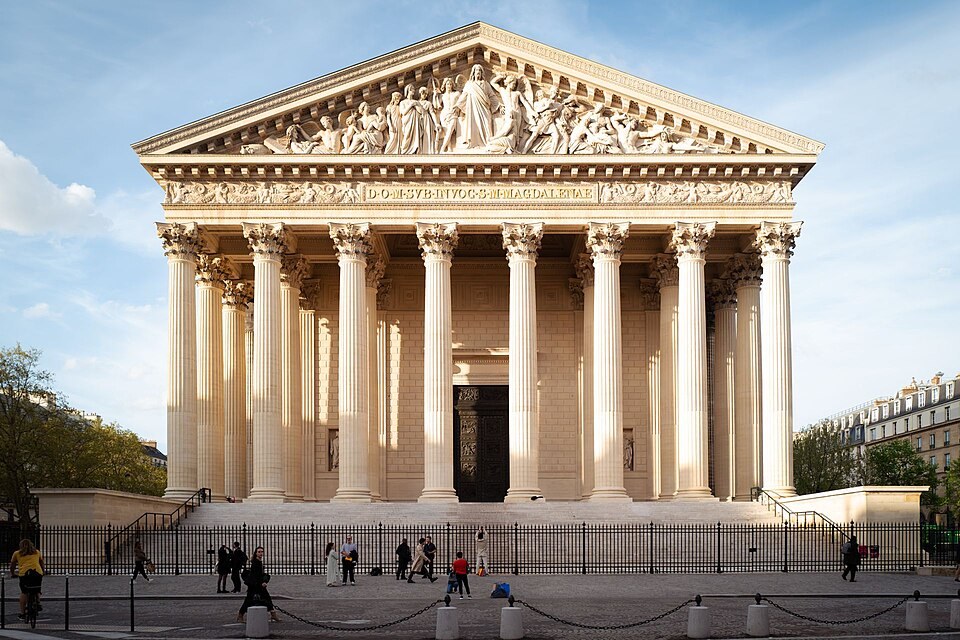
La Madeleine can look like an ancient temple unexpectedly placed among Parisian streets. Columns surround the building, a raised base separates it from daily movement, and a triangular pediment completes the main front. This is not a surviving Roman structure, however. It is a much later church with a complicated history of changing intentions.
The project began under Louis XV. Construction extended across major political upheavals, and successive regimes reconsidered what the building should become. During the Napoleonic period, it was intended as a temple to the glory of the army. Later, it was completed as a Christian church and consecrated in 1842.
These changes help explain its unusual appearance. Classical forms provided a flexible language of public grandeur. They could serve a state monument as well as a religious building. Architectural form does not always communicate one unambiguous function. Here, the image of an ancient temple contains a history in which the intended purpose was repeatedly revised.
Look at the columns continuing along the side elevations. They are not merely decoration applied to the principal façade; they establish a spatial boundary around the whole building. As you move, the gaps appear to open and close, changing the relationship between the columns and the substantial mass behind them. La Madeleine rewards movement rather than only one perfectly frontal view.
Its position also matters. The church belongs to a network of major Paris perspectives, close to Place de la Concorde and important shopping streets. It exists both as a place of worship and as an urban landmark. Many people pass it repeatedly on ordinary errands, experiencing it mainly as a stable point within a familiar route.
If you enter, compare the exterior’s ancient-temple image with the Christian purpose of the interior. There is no need to resolve that difference. The coexistence of historical languages is part of the building’s character.
From outside, you might ask how the place would have developed if one of its earlier proposed uses had been carried through completely. Any answer would remain hypothetical, but the question itself reveals how strongly architecture can depend on changes of political power.
La Madeleine is therefore more than an impressive ring of columns. It is the visible outcome of a long discussion about whom a city monument should honour and what role it should perform. The completed church preserves traces of ambitions that never fully became its final purpose, making it a particularly clear example of history changing a building while construction was still underway.
Learn more
Neoclassicism does not necessarily mean copying one ancient temple in every detail. Architects used classical forms as a language: columns, pediments, proportions and an image of ordered grandeur. That language is especially visible at La Madeleine because the surrounding colonnade dominates its silhouette. Distinguish the age of the architectural model from the actual date of construction. An appearance of antiquity can be a deliberate artistic choice made in a much later period.