LISTEN TO THE PLACE
A story worth knowing
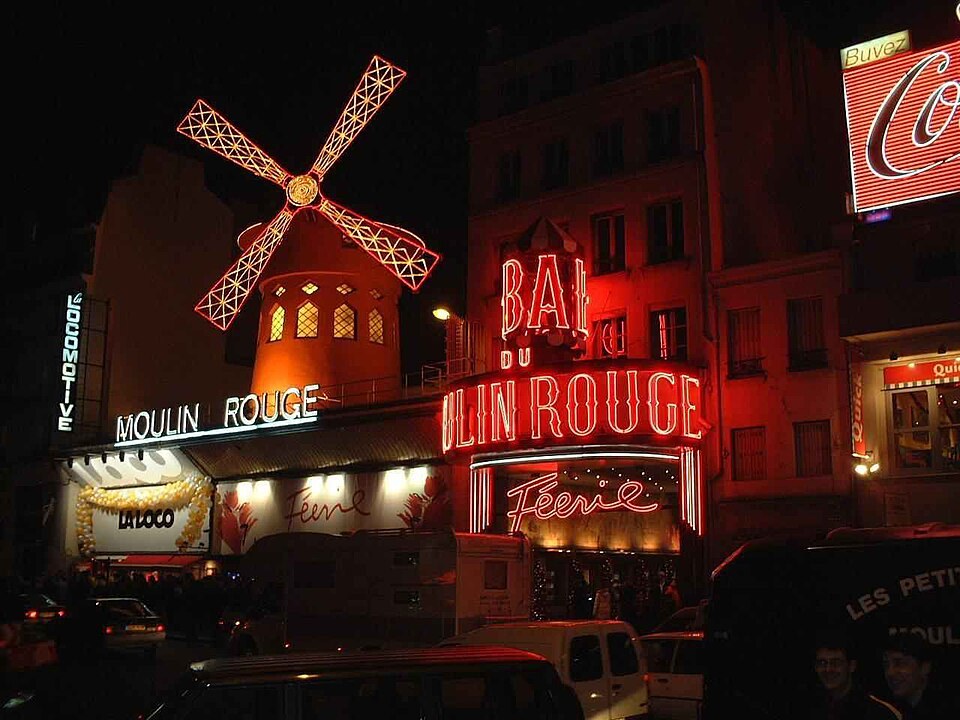
The red windmill above the Moulin Rouge is one of the most recognisable signs of Parisian nightlife. It is not a surviving rural business accidentally surrounded by entertainment venues. The mill functions primarily as an image and a sign, promising a particular world beyond the entrance.
The cabaret opened in 1889, during an era of expanding mass entertainment and new forms of urban leisure. Around the foot of Montmartre, dance halls, theatres and cafés helped create a distinctive environment. Different audiences met here, and entertainment became an important part of both the local economy and the district’s reputation.
French cancan is especially strongly associated with the Moulin Rouge. Its energy, speed and theatrical boldness came to symbolise a particular idea of Paris. The dance’s entire history should not be reduced to an invention on one evening in one room, however. Its stage forms developed and changed, while the cabaret helped make it internationally recognisable.
Advertising played a major role in the fame of such venues. Posters did more than announce a performance date. They created memorable silhouettes and personalities, turning performers into urban celebrities. Late nineteenth-century Paris learned to encounter a show before buying a ticket, through printed images displayed in the street. The history of the cabaret therefore also belongs to the history of poster art and public visual culture.
The building and its programmes have changed repeatedly over time. The present Moulin Rouge is not an untouched stage preserved exactly as it stood in 1889. Its continuity lies more in the name, the image and the ongoing reinvention of spectacle. The red windmill became a sign recognised even by people who know nothing about a particular production.
For this walk, we are treating the venue as an exterior stop. Attending a show is a separate decision involving booking, cost and the establishment’s current rules. You do not have to enter to understand its role in the city’s imagination.
Look at how a comparatively small silhouette above a roof can evoke an entire era of entertainment and theatrical freedom. Then notice the ordinary street around it. The contrast between the legendary name and daily movement is revealing: famous Paris exists within a working city where people commute, earn a living and return home.
That is part of the attraction rather than a disappointment. The Moulin Rouge is both a carefully maintained international symbol and a real venue in a changing neighbourhood. Seeing those two identities together gives a fuller understanding than treating the façade as a doorway directly into an unchanged nineteenth century.
Learn more
A cabaret, concert hall and opera house may all offer music and performance, but they developed different relationships with their audiences. Cabaret places particular emphasis on atmosphere, proximity and a sequence of varied acts. Comparing it with an opera house only by stage size misses the point. The Moulin Rouge belongs to a distinct strand of Parisian entertainment culture in which the venue’s identity and the ritual of an evening matter greatly.