LISTEN TO THE PLACE
A story worth knowing
Notre-Dame's two towers appear calm and almost alike. Lower your gaze, however, and the façade becomes a dense world of arches, figures and carved lines. The cathedral stands on the Île de la Cité. Water separates it from the banks, while bridges continually connect it with the city's movement.
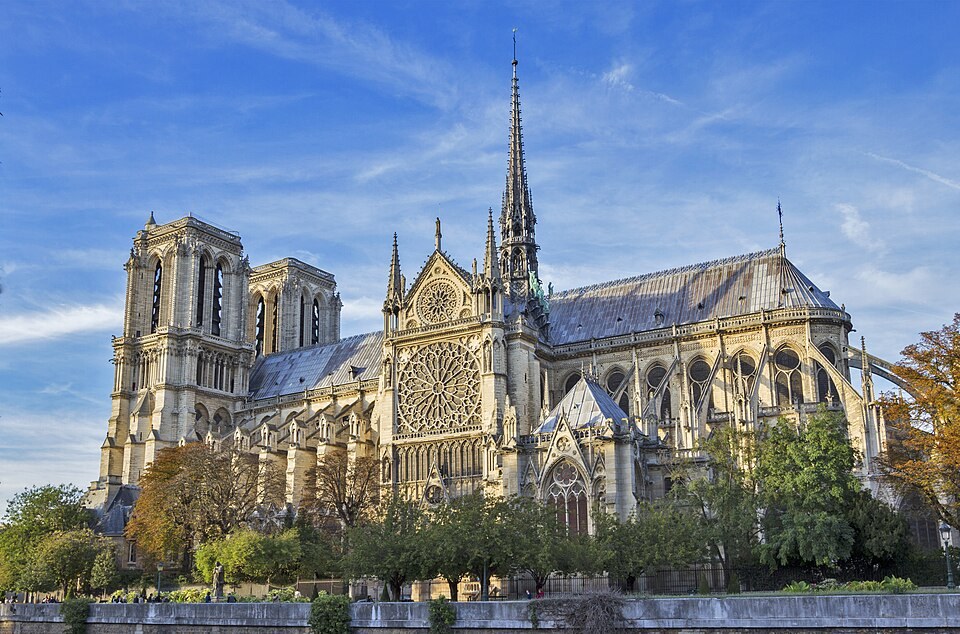
Construction began in the twelfth century. In this Gothic architecture, stone does more than form a heavy shell. Vaults and external supports distribute loads and make room for larger windows. Gothic design is therefore worth understanding not simply through pointed arches, but through the search for light within a substantial building.
Notre-Dame has changed repeatedly. Revolutionary damage, nineteenth-century restoration and reconstruction after the fire of two thousand and nineteen belong to different chapters. Not every recognisable detail is an untouched medieval original. That does not make the cathedral less authentic as a historic place. Its life includes destruction, debate over restoration and the labour of later generations.
Literature also influenced the building's fortunes. Victor Hugo's novel, known in English as The Hunchback of Notre-Dame, strengthened interest in the monument during the nineteenth century. Quasimodo and Esmeralda are fictional characters, however, not people whose biographies should be sought in cathedral archives. A story can help make a place beloved while remaining an invention.
If conditions allow you to walk around, compare the main façade with a side view. From the front, symmetry holds your attention. From the side, the more complex system of supports becomes apparent. You almost encounter two buildings: a ceremonial public image and the visible work of a structure. Check current arrangements separately if you intend to enter. This account can also be enjoyed from public space outside.
Before leaving, look at the cathedral together with the river. A photograph can easily turn it into an isolated monument. Here, the island, bridges and quays explain its position within Paris. Notre-Dame matters not only as a work in stone, but also as a place to which the city repeatedly returns, after an ordinary walk, a historical change or a shared loss.
Learn more
Distinguish a gargoyle from a fantastic figure used only as decoration. A gargoyle has a drainage function, while a sculpted creature may be purely ornamental. Nor does every familiar image on an old building necessarily date from the Middle Ages. Nineteenth-century restorers created details now closely associated with Notre-Dame. Asking what a figure does can be more revealing than immediately trying to identify its name.