LISTEN TO THE PLACE
A story worth knowing
The dome above the Latin Quarter belongs to a building whose purpose has changed repeatedly with the history of France. Today, the Panthéon is a monument of national remembrance. It began, however, as a church dedicated to Saint Genevieve, the patron saint of Paris.
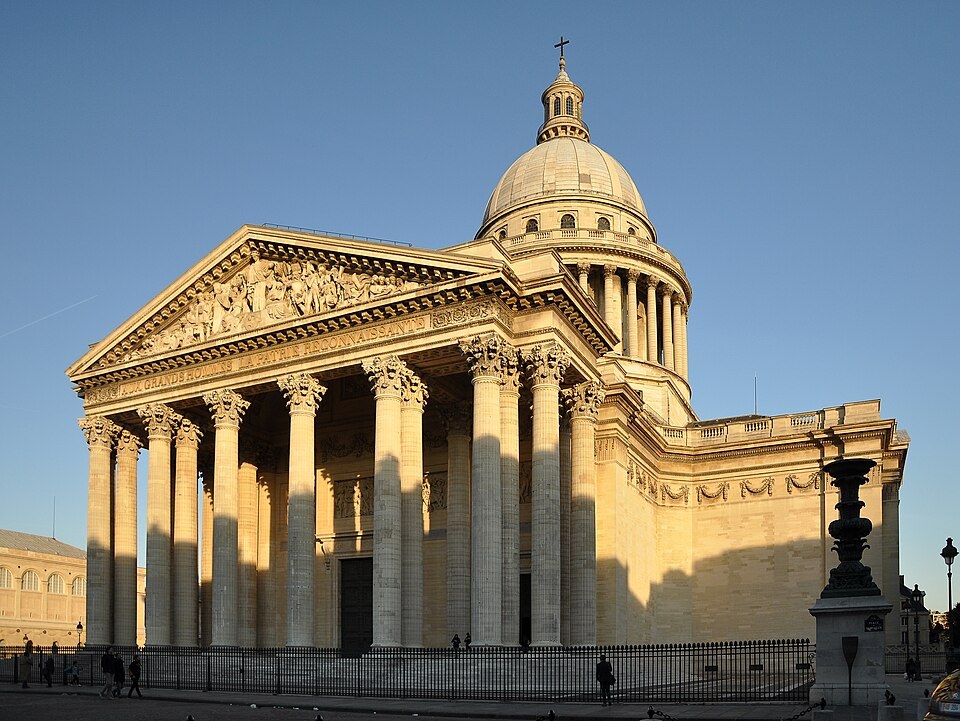
In the eighteenth century, King Louis XV supported the construction of a new church here. Architect Jacques-Germain Soufflot sought to combine the grandeur of classical forms with a sense of structural lightness. Look at the columned portico: it recalls an ancient temple. Above it rises a much more complex domed composition, designed to occupy a commanding place in the city skyline. This is a different architectural language from medieval Gothic, built around classical models, proportion and ordered surfaces.
The French Revolution transformed the project’s meaning. In 1791, the building became the Panthéon, a burial place honouring distinguished citizens. Throughout the nineteenth century, its religious and secular functions continued to alternate. The change was not a simple, permanent journey from church to national monument. Successive political regimes reconsidered what the building should represent. Its secular role was firmly established after Victor Hugo’s funeral in 1885.
The inscription on the façade offers the gratitude of the nation to its great figures. But who deserves that honour? The answer has evolved. The people commemorated here, and the ceremonies through which new figures are admitted, reflect changing ideas about achievement, courage and public service. The Panthéon is therefore not merely a finished list of famous names. It is part of an ongoing debate about national identity.
Science also has a memorable place in this story. Foucault’s pendulum made the rotation of the Earth visible to a public audience. At first, an experiment in physics may seem unexpected in such a solemn interior. Yet it fits a monument that increasingly associated greatness with intellectual achievement, rather than only with military victory or political power. The movement of a pendulum can express a different kind of human ambition.
Step back safely and compare the calm repetition of the columns with the dome rising above them. The building resembles both a temple and a state monument because it has genuinely served both purposes. Its architecture retains those layers even when its official function changes.
You do not need to memorise every name associated with the crypt to understand this stop. Instead, consider how a country uses a shared building to discuss whom it wishes to remember, and why. The Panthéon gives that difficult conversation a highly visible place in the city.
Learn more
Foucault’s pendulum does not simply turn like a clock hand. As it swings freely, its plane of oscillation changes relative to the rotating Earth, at a rate that depends on latitude. The Paris demonstration of 1851 became famous because it made a planetary motion observable inside an ordinary building. Visitors could witness evidence of the Earth’s rotation without leaving the ground. Check the current display arrangements before planning a visit around the experiment.