LISTEN TO THE PLACE
A story worth knowing
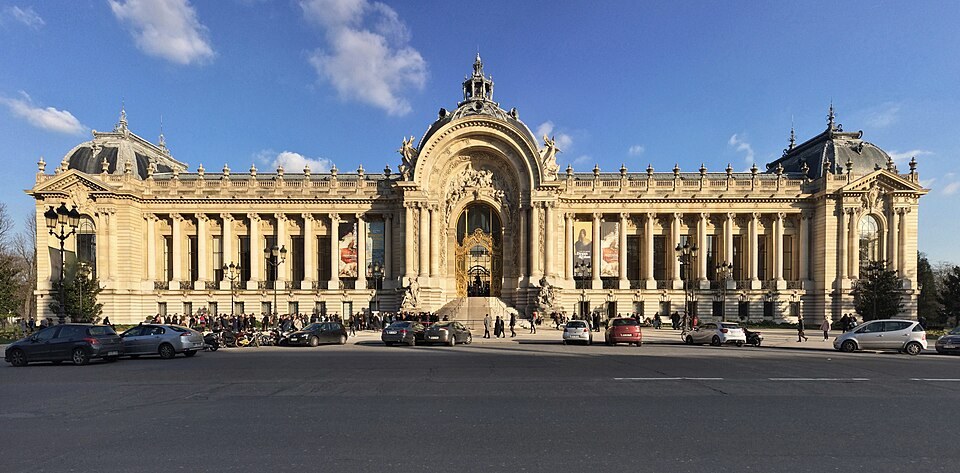
The “small” in Petit Palais can be misleading. This is hardly a modest house: it has a monumental entrance, elaborate sculpture and carefully controlled proportions. It is small primarily in relation to the Grand Palais standing opposite.
Both palaces were created for the Universal Exhibition of 1900. Their proximity establishes an architectural conversation. The Grand Palais impresses through its enormous covered volume and glass roof; the Petit Palais offers a different scale, more closely associated with a museum visit. Together, they demonstrate how one international celebration could leave a lasting ensemble within the city.
The building now houses the City of Paris Museum of Fine Arts. That distinction matters: calling it a palace does not mean that a royal family necessarily lived in its rooms. It belonged from the outset to the world of exhibitions and the public presentation of art. Its grandeur expresses the dignity assigned to culture rather than the private status of a monarch.
Read the façade as a sequence of visual accents. The central entrance draws attention, the side sections establish balance, and decorative figures enrich the rhythm. Close up, individual materials and details become visible. From further away, they are meant to combine into a clear whole. That coherence helps explain why the building feels festive rather than merely overloaded.
The museum’s collection covers different periods. It can be rewarding to set aside the expectation of one famous masterpiece that makes everything else a preliminary exercise. An encounter with an unfamiliar painting or object may produce a more personal visit. When accessible, the internal courtyard garden adds another change of light and pace to the sequence of galleries.
If you are staying outdoors, compare the entrance with the lines of the Grand Palais across the street. Each building has its own character while speaking the architectural language of the same period. Their relationship is as interesting as either façade in isolation.
If you decide to enter, check the conditions for the permanent collection and temporary exhibitions separately, as they may differ. An attractive open entrance does not by itself explain which spaces or events require a particular ticket.
The Petit Palais also reminds us that Parisian art is not concentrated in only a few internationally famous museums. A wider network of civic collections exists beyond the best-known addresses. Sometimes a quieter encounter with one of them allows more attentive looking than a hurried attempt to complete a compulsory checklist. The name may say “small”, but the possibilities of a visit are not.
Learn more
Grand Palais and Petit Palais describe a pair, not a ranking of artistic value. A larger building does not make every exhibition more important, and a smaller one does not imply a secondary collection. Choose according to content, available time and your interests. Comparing the architecture fits naturally into one walking stop; an attentive visit to the exhibitions or galleries deserves a separate decision and a larger allowance of time.