LISTEN TO THE PLACE
A story worth knowing
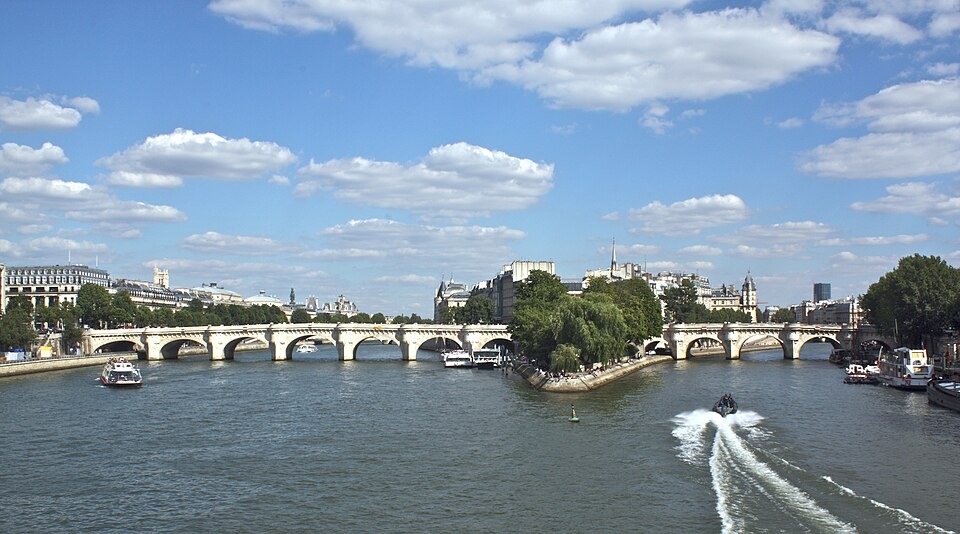
Pont Neuf means “New Bridge”. The surprising part is that it is the oldest surviving bridge across the Seine in Paris. Its name outlived the circumstances in which it was given: as earlier crossings disappeared or were replaced, the former newcomer became the historic survivor.
The bridge links both banks by crossing the western part of the Île de la Cité. It therefore consists of two sections over separate channels of the river, rather than one uniform crossing. This makes it an excellent place to understand the geography of old Paris. Island, embankments and opposite banks become parts of one visible system.
Its novelty was not simply a matter of date. Unlike many earlier Paris bridges, Pont Neuf was not lined with rows of houses. The river remained open to view. Crossing could become an experience of looking and strolling rather than moving through a narrow street suspended above water. That openness seems obvious today, but it represented an important urban choice.
The bridge is closely associated with Henry IV, whose equestrian statue stands on the island section. The present monument replaced an earlier statue destroyed during the revolutionary period. What we see therefore belongs partly to the history of remembering the king, rather than surviving unchanged from his lifetime. Many Paris monuments have experienced a similar sequence of removal and return.
Downstream, the green tip of the island extends towards Square du Vert-Galant. Its shape is a reminder that the banks of the Seine are not an eternal natural outline. Embankments, reinforcement and accumulated material have altered the island over time. The familiar cityscape emerged through a long interaction between the river and human construction.
Pause on the bridge and briefly set aside your list of sights. Look along the water, then back towards the island. The reason the Seine matters so much to the structure of Paris becomes immediately visible: it separates parts of the city while also connecting them. Boats, bridges and embankment paths create different forms of movement around the same channel.
Pont Neuf ceased to be a new engineering achievement long ago, but it still offers a defining quality of its original design: the chance to see the river. There is no need to hurry across merely to reach another attraction. The crossing itself is a complete stop, particularly when changing light brings different façades and reflections into view. A bridge can be a place to understand a city, not just a way to pass through it.
Learn more
The name Square du Vert-Galant refers to a nickname of Henry IV. Royal nicknames often turn a complex political figure into a memorable human character. That is part of historical memory, but not a substitute for a biography. Here, notice how the king’s image connects several features at once: the bridge, the equestrian statue and the green tip of the island. Together, they form a small cluster of remembrance within the cityscape.