LISTEN TO THE PLACE
A story worth knowing
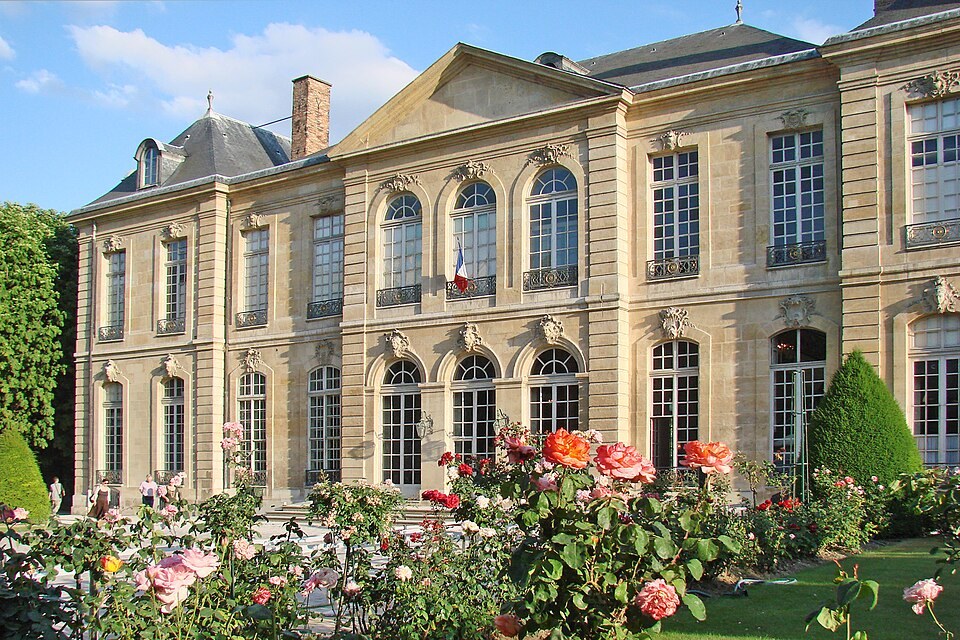
The Musée Rodin has a different tone from many large Paris museums. Instead of an immense ceremonial frontage, it offers a mansion and a garden. This is an especially fitting setting for a sculptor who expressed powerful inner movement through bodily posture, the surface of a material and forms that can appear deliberately unfinished.
The museum occupies the Hôtel Biron. Auguste Rodin worked here in the early twentieth century and gradually connected the future of his collection with the place. He gave works and possessions to the French state on the condition that a museum be created. It opened in 1919, after his death. This was therefore not a random building selected to contain an exhibition: Rodin himself helped establish its role in the continuing life of his art.
For many visitors, the best-known work associated with him is The Thinker. The seated figure has become an almost universal image of thought. Yet it began within a specific artistic project: The Gates of Hell, inspired by Dante. A figure connected to a much larger composition gained an independent identity. Its popular meaning now extends far beyond the context in which Rodin first developed it.
Rodin did not treat the human body as a perfectly calm outer shell. Muscular tension, the weight of a pose and the position of hands can communicate as much as a face. Surfaces may look rough or retain a sense of the sculptor’s working process. That is not necessarily a failure to finish. Uneven surfaces catch light and give the form a changing presence.
The garden encourages this kind of attention. Clouds alter the light; planting changes the background; a path gradually reveals a different angle. A sculpture is no longer a single fixed picture, as it might appear in a book. It unfolds as you move around it. The precise display and available routes can change, so treat familiar photographs as introductions rather than a guaranteed plan of today’s visit.
If you go inside, choose one figure and walk around it where permitted. Ask yourself what changes: its apparent balance, its weight, its expression, or the relationship between its parts? This can be more rewarding than quickly collecting the names of famous works.
Rodin’s museum demonstrates how still material can convey action, hesitation and effort. You do not need specialist vocabulary to begin seeing this. A few attentive minutes beside one sculpture may reveal more than a hurried circuit of the entire collection, especially when the light itself becomes part of the encounter.
Learn more
A bronze sculpture can exist in more than one cast. Seeing The Thinker in another museum does not automatically mean that one example is a forgery. Provenance, size, date and authorisation all matter. These are specialist questions in museum practice. For a visitor, the useful habit is to read the label rather than rely only on recognition: it explains which physical object, and which stage in a work’s history, is in front of you.