LISTEN TO THE PLACE
A story worth knowing
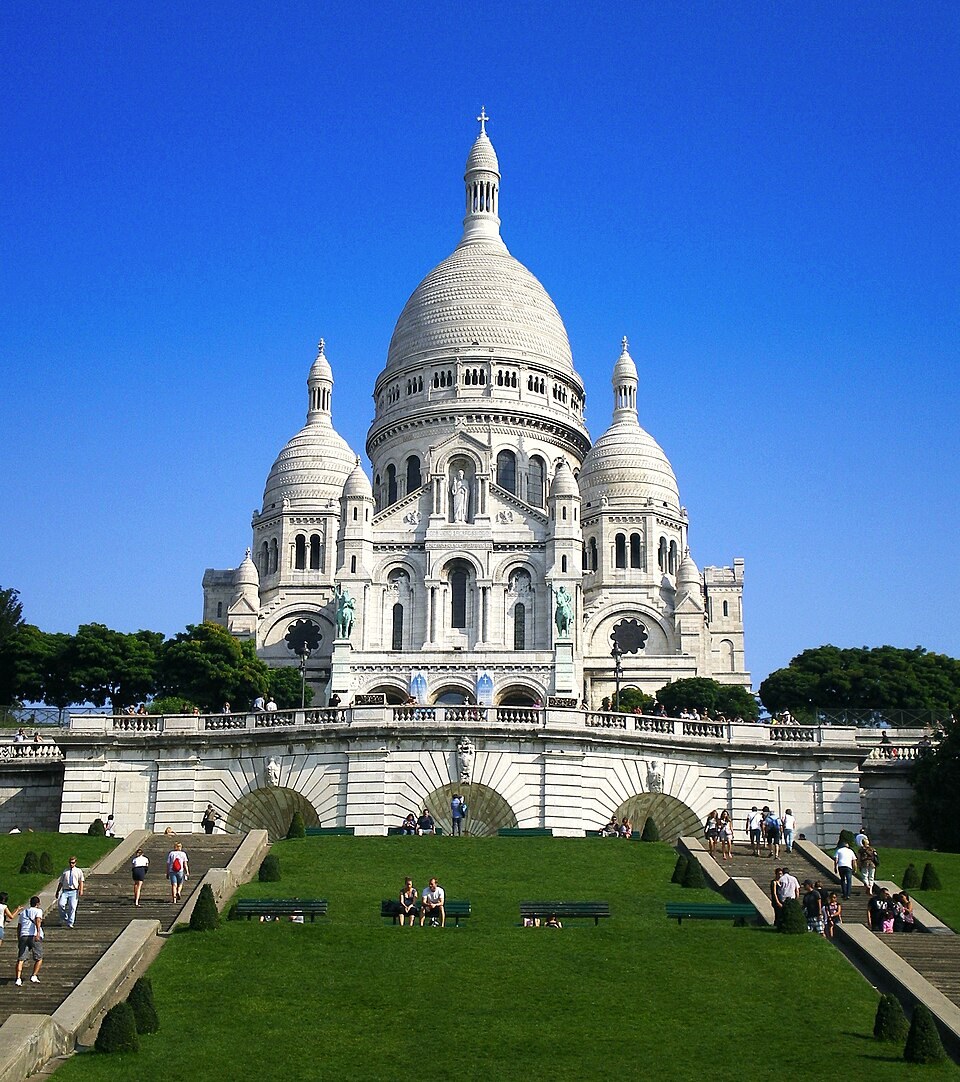
At the summit of Montmartre, Sacré-Cœur seems almost separate from the surrounding city. Pale domes stand against the sky, and the stairs make you feel the height through your own effort. Yet this is not an ancient church that happened to survive Paris's expansion. Construction began in eighteen seventy-five, and the basilica was consecrated after the First World War.
Paul Abadie's design draws on Romanesque and Byzantine forms. Its outline therefore differs markedly from Gothic Notre-Dame. Instead of two flat-topped towers and numerous pointed details, rounded domes and compact volumes dominate. Within one city, you can compare different architectural ideas of sacred space.
The basilica's origins belong to the difficult period following the Franco-Prussian War. Its meaning became politically contested, including through its position on Montmartre and its relationship with memories of the Paris Commune. This complicated history should not be reduced to a convenient story about one event. For some, the church expressed religious hope; for others, it recalled painful social conflicts.
Today, pilgrims, residents and visitors meet around it. Some have come to enter the church, others to enjoy the panorama. Those purposes can coexist if people recognise the different functions of the space. Inside is an active Catholic place of worship. Outside is one of the best-known views of Paris.
Look down and notice the overall pattern of roofs before searching for individual landmarks. The height reveals the city's density. At street level, a road fills your view; from here it becomes a narrow interval between buildings. Montmartre helps you understand Paris as a whole, even while seeming a world of its own.
If the ascent has been tiring, there is no need to hurry away. Compare the basilica's upward silhouette with the long horizontal spread of the city. Their contrast creates much of the experience. A relatively recent building has occupied its setting so effectively that it can seem inseparable from the shape of the hill itself.
Learn more
Montmartre has two geographies: distance and elevation. A short line on a map may include several stairways, while a longer route may be easier. When choosing the next stop, consider the actual walking route rather than metres alone. This is especially clear between the summit and the boulevard near the Moulin Rouge. Both belong to the same neighbourhood, but the journey connects very different levels and rhythms of city life.