LISTEN TO THE PLACE
A story worth knowing
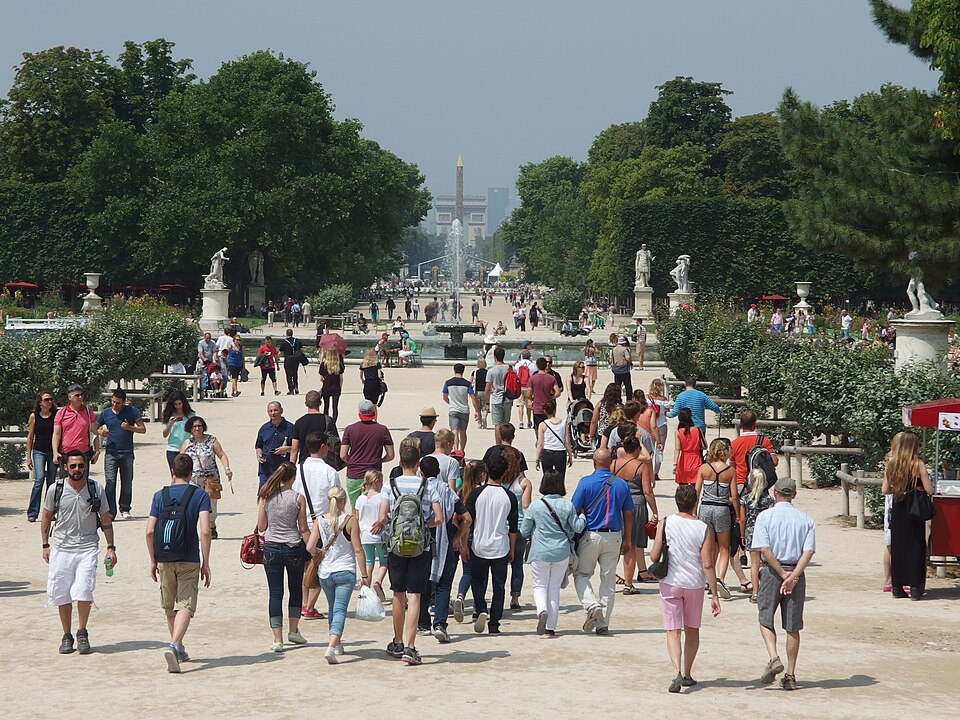
The long perspective through the Tuileries can feel like a natural feature of Paris. In reality, it is the result of centuries of decisions. The garden connects the Louvre with Place de la Concorde, while the eye continues further along a great urban axis. This is a good place to see how landscape can become architecture without a roof.
The name preserves a much less royal past. Tiles were once made in this area; the French word “tuile” means a roof tile. In the sixteenth century, Catherine de’ Medici began creating a palace and garden here, changing a productive site into a royal setting. Later generations reshaped the grounds. André Le Nôtre, the great designer of French formal gardens, made an especially important contribution.
A formal garden arranges plants, paths and water into a clear composition. Long axes and repeated lines guide the eye. But that does not make the Tuileries a frozen diagram. Wind, changing foliage, reflected light and people moving through the space continually alter the experience. The stable framework makes those variations more visible.
The Tuileries Palace itself has disappeared. It burned during the Paris Commune in 1871, and its ruins were later removed. Part of the openness we experience today is therefore the result of destruction. Looking towards the Louvre, remember that the view did not always exist in this form. An absent building can still shape the meaning of a place, even when none of its walls remain in front of us.
Over time, the royal garden became a public setting. Its geometry now accommodates meetings, walks and rest rather than the controlled life of a court. Sculpture introduces another layer of history, with works from different periods appearing among trees and basins. Some reinforce the garden’s formal rhythm; others invite you to pause and reconsider the familiar perspective.
Try walking a short distance along the main axis, then move to a side path. The contrast is striking. From the central line, you sense the scale of the city. From the side, the space returns to the scale of an individual walk. That combination helps explain why the Tuileries is more than a route between famous monuments.
You do not have to choose between appreciating its history and simply enjoying a break. Both uses belong here. Follow the garden’s signs and respect planted areas, then allow yourself a few unhurried minutes. The grand composition works just as well when you are sitting quietly as when you are looking for the perfect view.
Learn more
The lost Tuileries Palace illustrates an important feature of historic cities: an empty space can also record change. Old plans and prints show a very different relationship between the garden and the Louvre. Comparing them after your walk can be revealing. You do not need to reconstruct every missing wall in your imagination. Simply recognise that the familiar panorama emerged through building, destruction and later decisions, rather than from a single design.