LISTEN TO THE PLACE
A story worth knowing
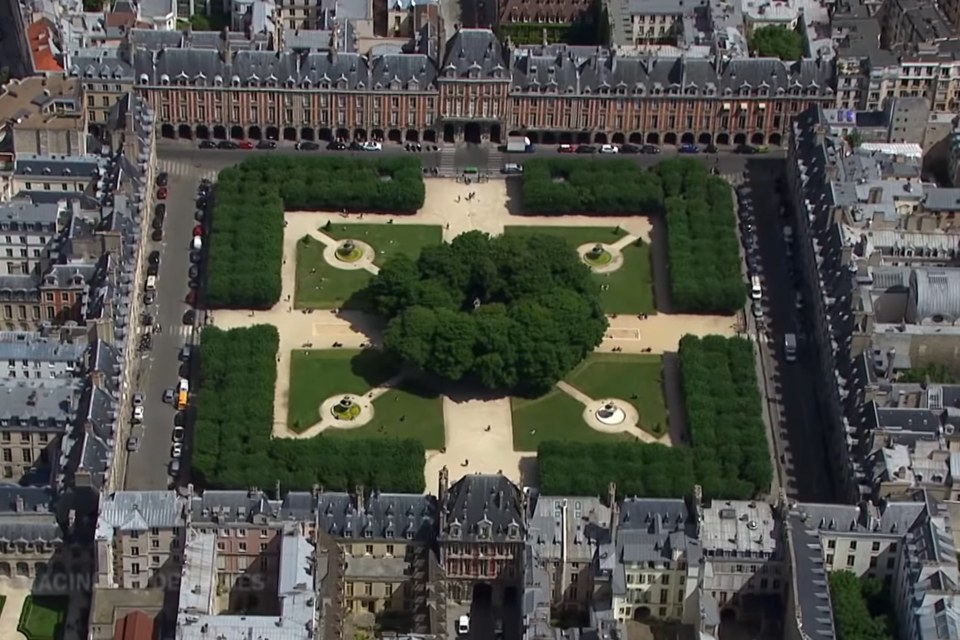
Place des Vosges almost encourages you to lower your voice. Red brick, pale stone, high roofs and covered arcades enclose the space like an outdoor room. Even when it is busy, the surrounding buildings establish a clear boundary between the square and the streets of the Marais.
The ensemble developed in the early seventeenth century under Henry IV and was originally called Place Royale. Its defining feature is the coordinated appearance of the buildings. Individual houses could have different owners, but together they were expected to create a single composition. For Paris, this was an important example of designing an urban setting rather than merely placing an impressive palace beside an unplanned open space.
Look at the contrast between materials. Brick supplies warmth; stone emphasises openings and architectural lines; dark roofs complete the upward movement. Covered galleries run beneath the houses, offering a second, more intimate way of moving around the square. From within them, the open space appears through a repeated sequence of arches, almost like a series of framed views.
During the seventeenth and eighteenth centuries, this was a fashionable and prestigious address. It reveals a side of the historic Marais that can be overlooked among its narrow streets and busy shops: the district also contains a strong history of aristocratic residences. The square’s present life, however, is far removed from an exclusively elite social world. Its garden, walkers, galleries and cafés fill the old framework with different habits.
Victor Hugo is associated with one of the houses, now a museum connected with his Parisian home. That literary connection does not turn the entire square into a backdrop for a single writer. Instead, it adds another layer to an older story of urban planning. Many Paris addresses belong to several histories at once.
Try walking beneath the arcades along one side, then look back at the same façades from the central area. From the open square, the overall order is most visible. From the covered gallery, individual details and the life around doorways and windows become more important. Both perspectives are part of the design.
Place des Vosges works through a balance of unity and small differences. It demonstrates that architectural order does not have to mean monotony. You can understand much of its character simply by changing your position, without needing a long list of dates. The enclosing buildings themselves tell the story of a carefully imagined piece of city that has continued to accommodate new ways of living.
Learn more
After the revolutionary period, the square’s royal dedication gave way to the geographical name of the Vosges. Political change can alter the name of a place even when its architecture remains recognisable. Remembering the earlier title helps when looking at old prints or historical writing: Place Royale and today’s Place des Vosges may refer to the same space at different stages of its history.