LISTEN TO THE PLACE
A story worth knowing
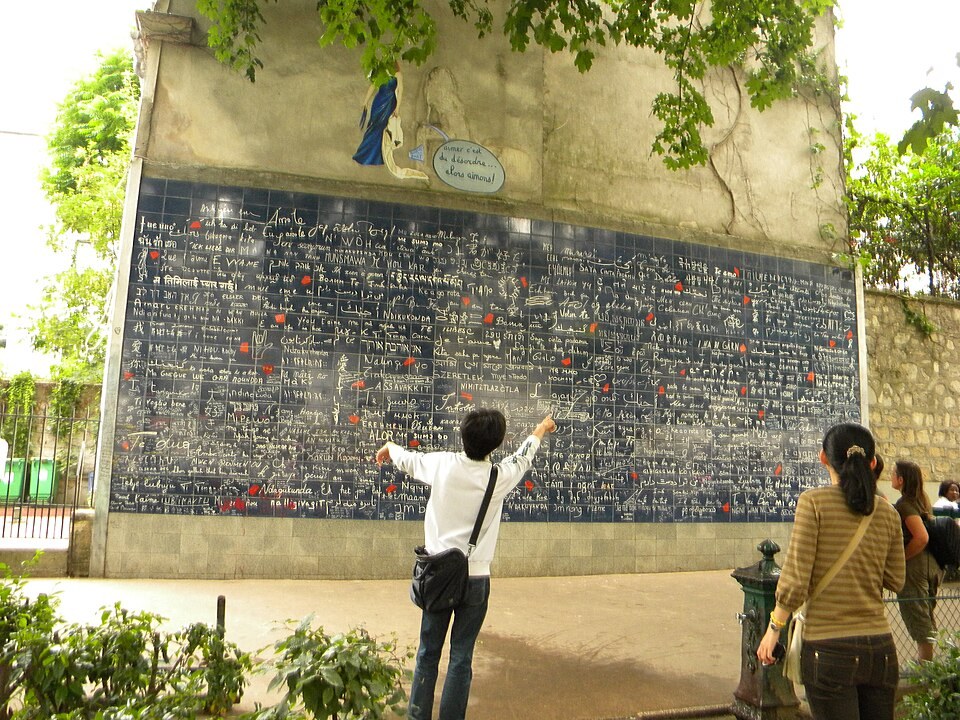
At the Wall of Love in a small Montmartre square, visitors often share the same activity: searching for familiar words among many inscriptions. This is a work that invites more than observation. It asks people to recognise themselves within a shared statement.
The installation was created in 2000 by Frédéric Baron and Claire Kito. Across a surface of ceramic tiles, declarations of love appear in different languages and written forms. The idea is simple, and that simplicity makes it approachable. You do not need a background in art theory to begin looking for your own version of “I love you”.
From a distance, the inscriptions create an overall graphic rhythm. As you move closer, the surface separates into individual lines and becomes a place for reading. Some signs are familiar; others cannot easily be pronounced without help. Your position shifts repeatedly between confidence and the experience of encountering an unfamiliar language.
The name can suggest universality, but it should not be taken as a literal claim that every language and every possible expression of affection is represented. The work offers a symbolic image of multilingual communication. Its purpose is not to complete an exhaustive dictionary, but to bring different ways of expressing a related thought into one shared view.
The use of a wall is significant too. A wall ordinarily divides, limits or blocks a view. Here, the artists turned it into a surface of connection. That is an artistic proposition, not a claim that cultural differences disappear through one phrase. Differences remain visible: varied scripts, letter shapes and directions of writing are central to the work’s appearance.
Try finding a language you know, then pause over a line you cannot read. You already understand the broad intention, while encountering another way of recording it. That small experience can make multilingualism feel concrete rather than abstract.
If the square is busy, leave space for others to approach and avoid occupying the wall for a prolonged photograph. It is a shared attraction within a small neighbourhood space, so consideration makes the visit better for everyone.
This stop provides a quieter counterpoint to the larger images of Montmartre. Instead of a panorama across all of Paris, it offers a close view of a few words. It reminds us that an international city is made not only from buildings and streets, but also from the languages of people who meet within it. Here, those languages become the material of the monument itself.
Learn more
Translating a declaration of love is not always a mechanical substitution of three words. Languages express relationships, intimacy and forms of address differently. The wall does not explain every nuance, but it can prompt a conversation with someone who knows a particular language. That is more useful than assuming each inscription is a grammatical copy of the English phrase. A shared theme connects the lines while their differences preserve the richness of communication.