LISTEN TO THE PLACE
A story worth knowing
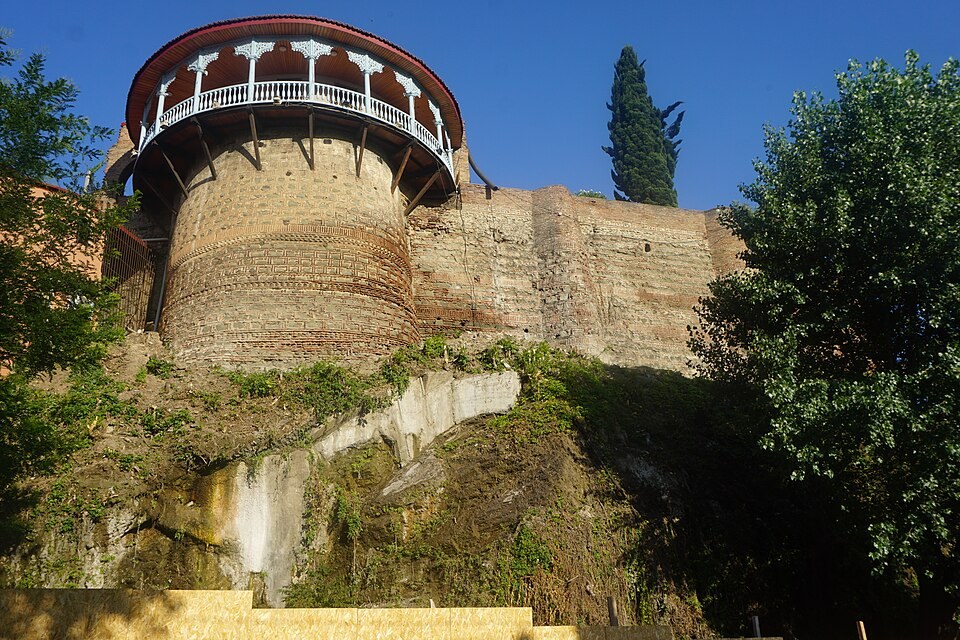
At Queen Darejan's Palace, your eye quickly finds the rounded pale-blue balcony. It projects above a massive support and appears light beside the heavy masonry. The combination is unusual: below, the building resembles a fortification; above, it suggests a house with a pleasant place to sit outdoors. That contrast has made the palace one of Avlabari's memorable images.
The complex, also known as Sachino, was built in seventeen seventy-six for Darejan, the wife of King Erekle the Second. It incorporated remains of the city's older defensive system. Its fortified appearance is therefore more than theatrical scenery. For a royal residence of the period, a clear view and protection had practical value rather than simply adding dignity.
Notice what the projecting balcony does. It provides a wider field of vision than a window set in a flat wall. What now looks like an attractive photographic setting also helped people watch the approaches. Beauty and usefulness are not separate tasks here. An architectural feature can become expressive precisely because it solves a particular problem.
Darejan herself was more than the occupant of a handsome house. Her life was connected with political struggles during the final years of the Georgian monarchy. Following the Russian Empire's annexation of the eastern Georgian kingdom, she was forced into exile and ended her life away from Georgia. The important connection at this stop is that separation: the palace retained the name of a woman who could no longer return to it. The appealing balcony belongs to a more complicated human story than a postcard alone can suggest.
The complex subsequently changed functions and became associated with religious life. Do not assume that a complete set of royal rooms survives for unrestricted visits. Check local access arrangements. Even an external view reveals the composition: a solid lower section, different materials in the walls and a lighter wooden upper feature establish a clear contrast with one another.
Try viewing the palace first from accessible public space below, then from another permitted angle. The balcony's shape changes, and its support may appear more rounded or more flat. Compared with the great cathedrals, this is a relatively small landmark, yet its position on the terrain gives it considerable presence. In Tbilisi, an expressive silhouette often depends less on size than on the precise encounter between a building, rock, street and river.
Learn more
Separate the palace's original design, its later changes and its appearance today. Timber elements need repair more often than masonry, so a recognisable balcony should not automatically be treated as an untouched eighteenth-century object. Restoration can help preserve a monument's identity. That does not reduce its value, but makes the way we look more precise. We are seeing a historic composition maintained and renewed by different generations.