
LISTEN TO THE PLACE
A story worth knowing
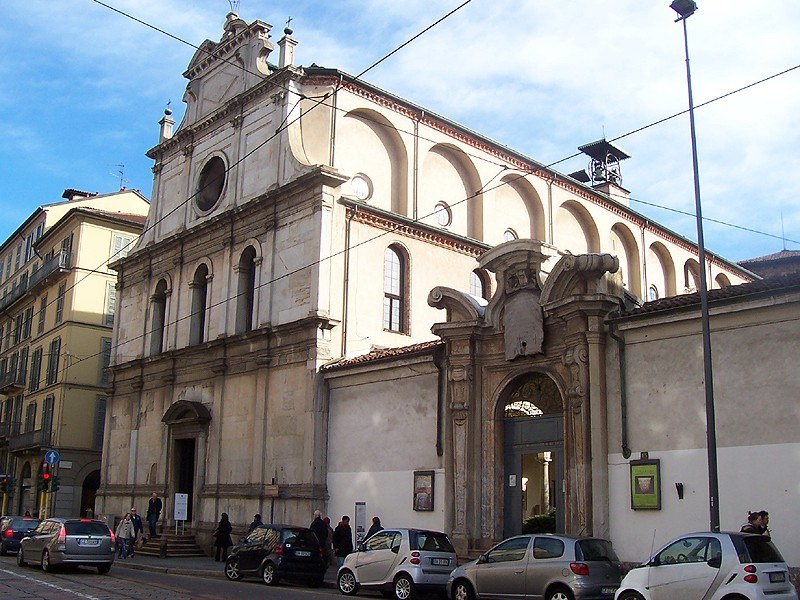
From the street, San Maurizio may appear to be one more historic church in Milan. Its great surprise is behind the doors. Inside, the walls become an almost continuous painted environment. Figures, architectural settings and biblical scenes surround the visitor. City guides often call it Milan’s Sistine Chapel. That is an evocative comparison, rather than another official name.
The church belonged to a major Benedictine convent for women, known as the Monastero Maggiore. The convent itself was much older than the present church. During the sixteenth century, the newer building became a setting for painters of the Lombard school, including Bernardino Luini. His work helps connect this place with the artistic culture of Milan in the generation after Leonardo.
The interior has an unusual organising feature: a wall divides it into two sections. One was intended for lay worshippers, while the other served the enclosed community of nuns. Beneath the decorative richness lies a precise arrangement of everyday religious life. People could participate in worship without all occupying the same freely shared space.
If you go inside, try noticing that division before concentrating on individual pictures. The paintings did not simply fill spare wall surfaces. They accompanied different groups of people in different parts of one building. Architecture, imagery and the convent’s rules operated together.
There is no need to recognise every saint or decode every scene immediately. Select a small section and examine how the painter separates figures from their surroundings, describes folds of clothing or directs a character’s gaze. Nearby you may find a very different mood: solemn, dramatic, or narrative, like another page of an extensive illustrated book.
The contrast between the quiet exterior and the abundance within is particularly rewarding. Outside, the church belongs to an ordinary sequence of city buildings. Inside, it creates an environment intended for people who would return to the same images repeatedly over time.
On a short walk, such a place is easy to miss precisely because it does not compete loudly with every neighbouring facade. San Maurizio invites another way of exploring: finding a doorway beyond which the density of experience changes. You do not always need a new route across the city to encounter something unexpected. Sometimes a few additional minutes on a street already included in your walk are enough to transform your sense of Milan.
Learn more
A historical piece of gossip is associated with a scene of Saint Catherine’s martyrdom. The writer Matteo Bandello, a contemporary of the artists, connected the saint’s face with the Countess of Challant, who was executed in sixteenth-century Milan. The official city guide recounts this version. The suggested likeness should not be presented as a securely identified portrait. Its interest lies elsewhere: viewers looked for people from their own world within religious images. Sacred history could therefore become entangled with city gossip, anxieties and notorious legal cases.