LISTEN TO THE PLACE
A story worth knowing
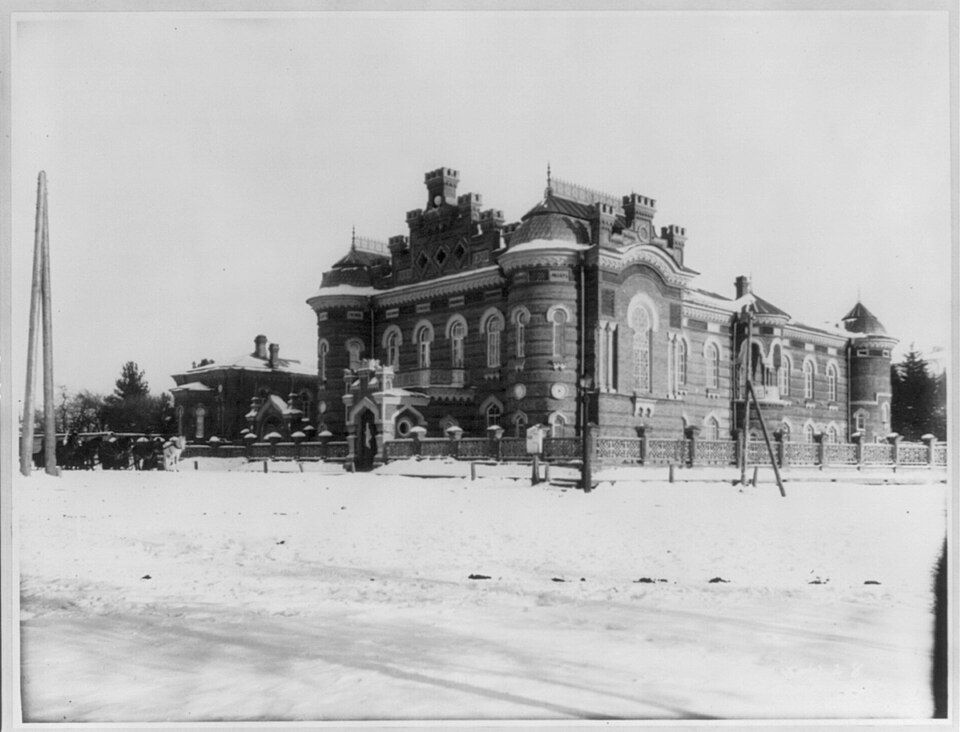
This unusual building has a story that begins with loss. In 1879, a major fire in Irkutsk destroyed the earlier museum, much of its collection and its library. The losses went beyond attractive objects for display. Years of collecting, recording and connecting evidence disappeared. The building before you was one response to that catastrophe.
Funds were raised for a new home, and the stone building opened in 1883. Its towers and distinctive appearance belong to a design by Heinrich Rosen, generally described as Moorish in style. Notice how the upper outline differs from an ordinary town house. It immediately suggests that something unusual awaits inside, although the institution’s purpose was the serious investigation of the world.
This housed the museum of the East Siberian branch of the Russian Geographical Society. The word “museum” does not cover the full programme. A library, laboratory, observatory and lecture hall also formed part of the institution. Imagine objects being examined, notes consulted, observations made and findings presented. The building helped turn experiences from expeditions into knowledge that other people could study and question.
Names of researchers appear on the façade. They make an unusual alternative to purely decorative ornament: the building asks you to read. You do not need to recognise every name. Choose one that is familiar, or one about which you know nothing. It may lead to a further question about travel and the study of Siberia. The façade acts almost like an invitation to open a book.
The museum itself is older than this house, tracing its history to 1782. That century-long difference illustrates why an institution’s founding date is not necessarily the age of its walls. The fire makes another distinction important: institutional continuity does not mean that every original collection survived. Continuing a museum’s work can involve rebuilding its material evidence almost from the beginning.
Today the building houses the history department of the regional museum. The larger institution has several departments and addresses, so this stop should not be confused with every other museum site in Irkutsk. The architecture merits attention even if you do not enter the exhibitions.
Before leaving, look once more at the researchers’ names. Behind them lies human work: lengthy journeys, observations, descriptions and discussion. Knowing about the fire makes that effort feel especially vulnerable. This building recalls both the ambition to discover new things and the responsibility to preserve knowledge already gathered.
Learn more
A museum object loses much of its value as evidence when its origin is unknown. A stone without a findspot, a possession without information about its owner or an undated photograph may still attract attention, but each is harder to place in a reliable account of the past.
That is why records and libraries matter alongside display cases. Walls can be rebuilt after a fire; a destroyed document or unique object may be impossible to recover. New collecting cannot simply reverse an earlier loss.
If you enter the museum, select one object and read its whole label. Notice its origin, date, material and acquisition history wherever these are provided. Such brief details connect a thing with people and places. Behind the visible exhibition lies the less conspicuous work of preserving those connections. That work makes a collection a source of knowledge rather than merely an assortment of interesting objects.