LISTEN TO THE PLACE
A story worth knowing
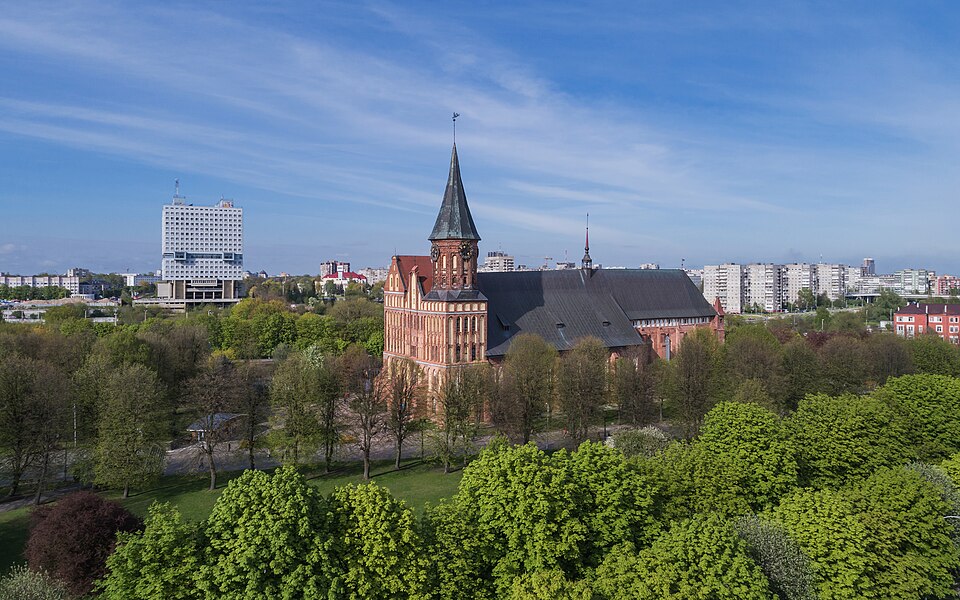
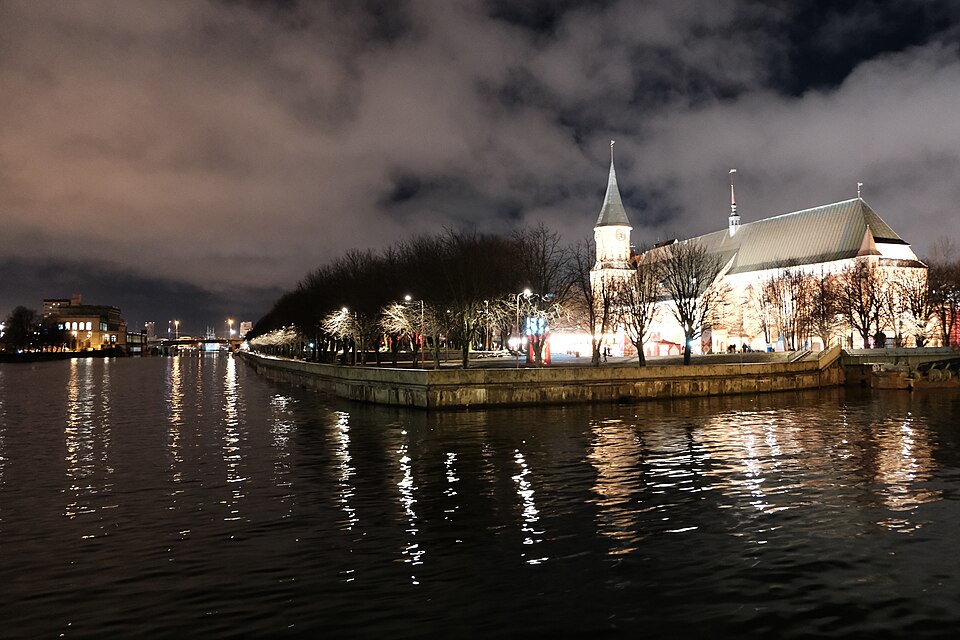
Look at the space around the cathedral. Between the trees, you can see paths, lawns and water. It feels as though the church has always stood in a park, with plenty of room deliberately left around it. That impression is misleading. This was Kneiphof, a densely built part of historic Königsberg. To picture the earlier island, mentally fill today's open spaces with houses and streets.
Air raids devastated the district in August 1944. The cathedral burned too, although its walls remained standing. The surrounding neighbourhood did not return. Today's landscape tells its story through absence as well as survival. Those generous views of the church reflect a profound break in the city's history, rather than the intentions of its medieval builders.
The green island took shape after the war. An arboretum was established in the 1960s, with trees and shrubs brought from different parts of the world. Even the vegetation has a history here. Compare two neighbouring trees: the outline of their crowns, the texture of their bark and the shape of their leaves. The park was created through human choices, rather than simply left to grow.
A sculpture park followed in 1984. Portraits of writers and composers share the grounds with other human figures and animals. They add a layer connected with Soviet cultural life. Outdoors, a sculpture works differently from a piece in a gallery. Branches interrupt its outline, changing light transforms a face, and you choose your own angle of approach.
The island also has an unexpected mathematical connection. Königsberg's historic bridges inspired a famous puzzle: could someone cross all seven bridges exactly once? Leonhard Euler demonstrated that the arrangement made this impossible. The problem was about connections, rather than stamina or finding the shortest distance. The lengths of the bridges were irrelevant to his conclusion.
Bridges still bring us to the island, while that old puzzle reminds us that an everyday walk can lead to a major idea. Just do not expect to find the historical seven-bridge arrangement intact on a present-day map. The city has changed.
Try looking at the island at three different scales. First, take in the cathedral's outline across the water. Then examine one tree or a sculpted face. Finally, imagine the vanished streets around you. Together, these views reveal a place shaped by destruction, planting and remembrance, with several chapters of Königsberg and Kaliningrad occupying the same small patch of land.
Learn more
Why did Euler not need to measure any bridges? Imagine turning each piece of land into a dot and each bridge into a line. River bends and distances disappear, but the possible connections remain.
Whenever you enter a piece of land by one bridge and leave by another, you use bridges in pairs. The beginning and end of your walk may be exceptions. In the historical Königsberg arrangement, four pieces of land had an odd number of bridges attached. Two possible exceptions could not account for all four, so trying another route could never solve the puzzle.
Euler's 1736 work became a landmark in the history of graph theory. Here, a graph means a network of points and links. Transport systems and connections between web pages can also be examined as networks. A question about walking around this island turned out to have implications far beyond its riverbanks.