LISTEN TO THE PLACE
A story worth knowing
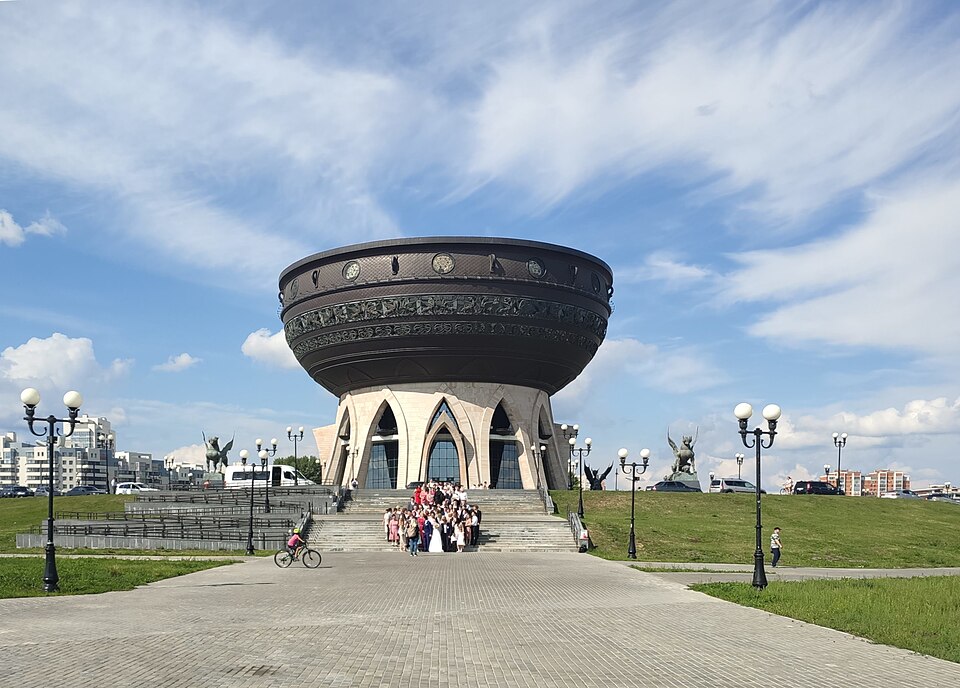
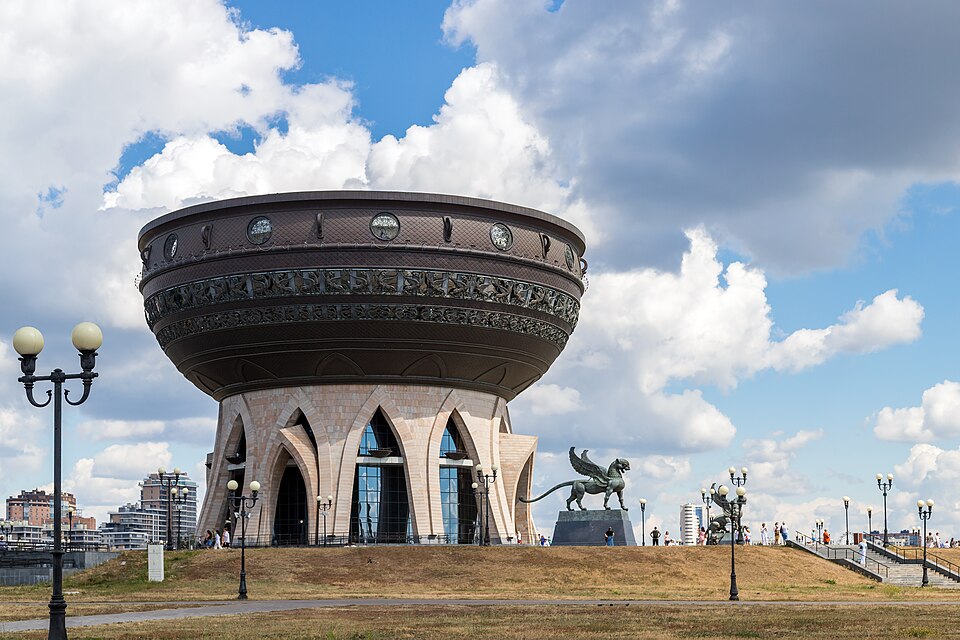
The main image is hard to miss: this building resembles an enormous cauldron. Its name is the Kazan Family Centre. A familiar household object has become a skyline landmark, visible from different points near the river. But the building's purpose concerns marriages rather than cooking.
The centre opened in two thousand and thirteen. Sculptor Dashi Namdakov created the architectural concept. A cauldron suggests a hearth and a shared table, linking the idea of family to a place where people cook, talk and take part in everyday life together.
Imagine shrinking the building to the size of a real cooking pot. Which features make the object recognisable? Now see it again as a building with rooms and people moving inside. The interest lies between those two views: an ordinary thing has become architecture without losing its familiar outline.
Sculptures of animals and fantastical creatures stand around it. The composition He and She, also associated with Namdakov's work, was added after the building opened. Zilants and snow leopards with young continue the family theme, this time through relationships between figures rather than the shape of a structure.
Look beyond each figure on its own. Where do the heads turn? How are the larger and smaller animals positioned? How much space lies between them? Sculpture tells a story through posture and arrangement, without needing a written explanation for every detail.
The zilant is familiar from Kazan's symbolism. These sculptures are nevertheless contemporary artworks, not ancient objects or precise illustrations of one definitive old legend. They can be appreciated both for their local associations and for the artist's individual interpretation.
The centre stands across the Kazanka from the Kremlin. That makes the surroundings as interesting as the building: you can look back towards the historical city from a different distance. The indoor observation area is a separate visit whose access conditions should be checked. An outdoor walk already offers the broad river landscape.
Before leaving, bring together the two scales of this stop. There is the large, almost storybook landmark, and there are the personal events of people beginning married life here. Behind the spectacular architecture is a human occasion that needs no knowledge of dates or names to understand.
Learn more
A cauldron readily becomes a symbol of a shared home: food is prepared in it and divided among people. But the Family Centre's shape should not be treated as proof of the historical origin of Kazan's name. That is a separate question with different explanations and traditions.
Distinguish an artistic association from an established etymology. An architect can use an evocative idea without claiming to settle a linguistic debate. Other cities also turn wordplay or local imagery into landmarks. The success of such a design does not depend on whether it literally explains where the place name came from.