LISTEN TO THE PLACE
A story worth knowing
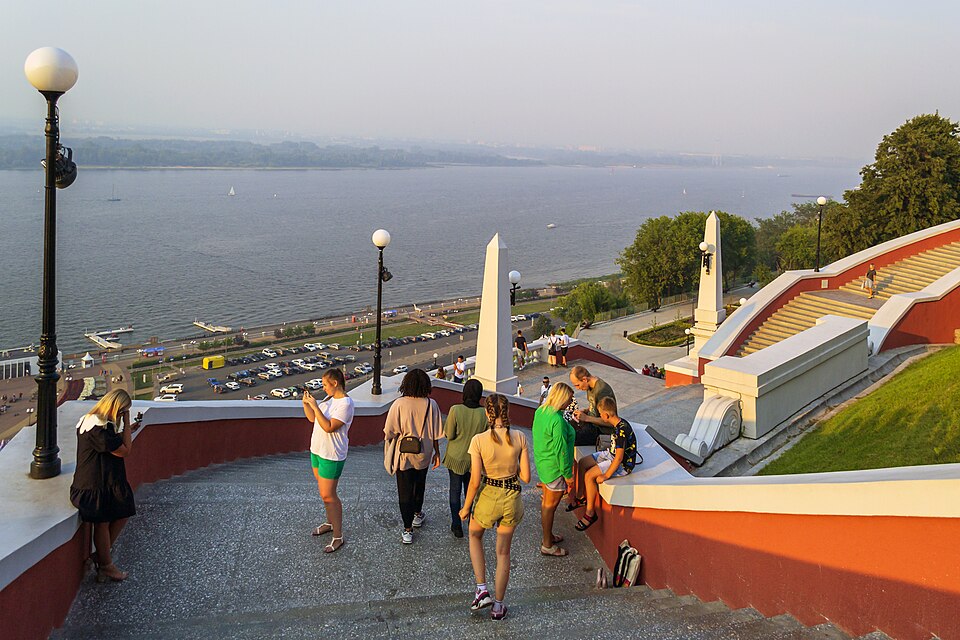
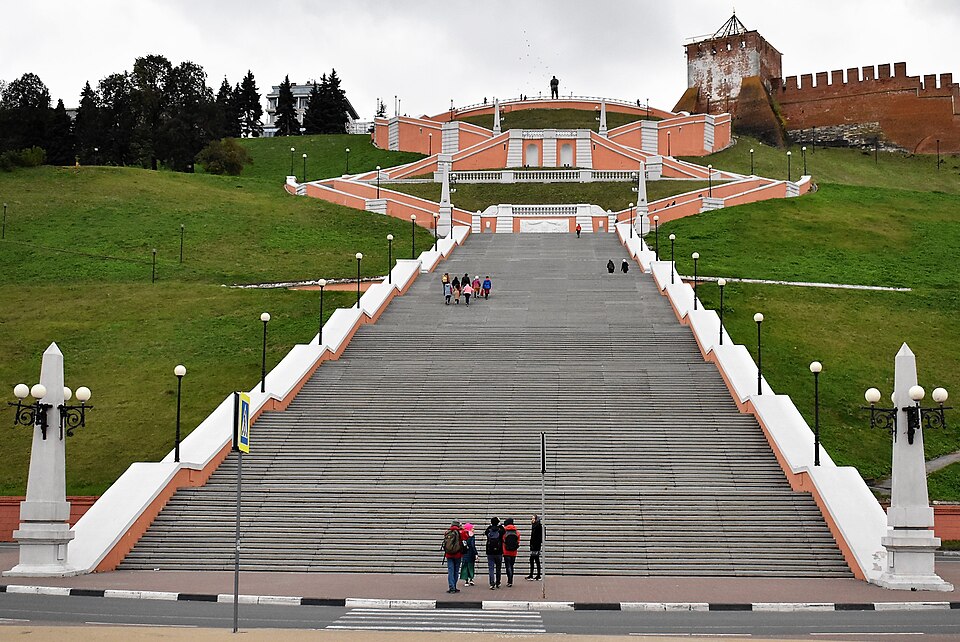
From the top, the stairs invite you down towards the Volga. From the bottom, they can look like a challenge before returning to the upper town. Seen from the river, they become an enormous drawing on the slope: flights divide and rejoin in a figure-of-eight pattern. Each viewpoint helps explain how a connection between two embankments became a symbol of Nizhny Novgorod.
The project took shape during and after the Second World War. Construction began in 1943, and the stairs opened in the summer of 1949. They were associated with the Soviet victory at Stalingrad. Initially called the Volga Stairs, they became widely known by the name of the aviator whose monument stands at the top: Valery Chkalov.
His monument had been installed in 1940. Chkalov came from the Nizhny Novgorod region and became one of the best-known Soviet pilots. In 1937, he was part of the crew that flew from Moscow across the North Pole to Vancouver in the United States. That means Vancouver, Washington, rather than the better-known Canadian city. The distinction can unexpectedly redraw a familiar aviation story on a listener's mental map.
Look at how the stairs organise movement. They do not simply take the shortest route down. The flights turn walkers in relation to the view, while landings provide places to pause. Even without completing the full descent, you can experience architecture directing your attention. The change in height that might normally obstruct a pedestrian has become the principal attraction.
At the foot stands the boat Geroy, meaning Hero, placed on its pedestal in 1985. It served with the Volga military flotilla and is associated with the fighting at Stalingrad. The aviator above and the vessel below create another relationship across the slope. The stairs connect memorials as well as different levels of the town.
Pause on a landing and choose where to look. Facing the river opens the scene outwards; facing uphill makes the steepness more tangible. A short movement can produce two contrasting impressions. That is the strength of this structure: it works both as a distant emblem and as a sequence of personal encounters. The long descent becomes a succession of turns, pauses and changing frames. A figure eight familiar from photographs turns into a route experienced at the pace of your own steps.
Learn more
How many steps are there? Descriptions often give 560, but a walker following one route may count fewer. That is not necessarily a mistake: the structure has branching flights. Its total number of steps differs from the number on a single ascent. The right-hand route is commonly listed as 442.
This is a small lesson in measuring architecture. Consider the stairs as an object, and you may want to add every part. Walk them, and only your chosen path contributes to the effort. Both measurements are useful when the distinction is clear.
There is no need to turn the visit into a test of the guidebook. Choose a section that suits your energy and remember the return journey. The figure eight is interesting precisely because its branches and landings offer different ways to experience the same slope, even when the starting point and destination appear straightforward.