LISTEN TO THE PLACE
A story worth knowing
Alexander Monastery above the Kamenka introduces a quieter side of Suzdal. Its foundation tradition attributes the community to Alexander Nevsky in 1240. That is a story about its origins, not the construction date of the buildings now before us.
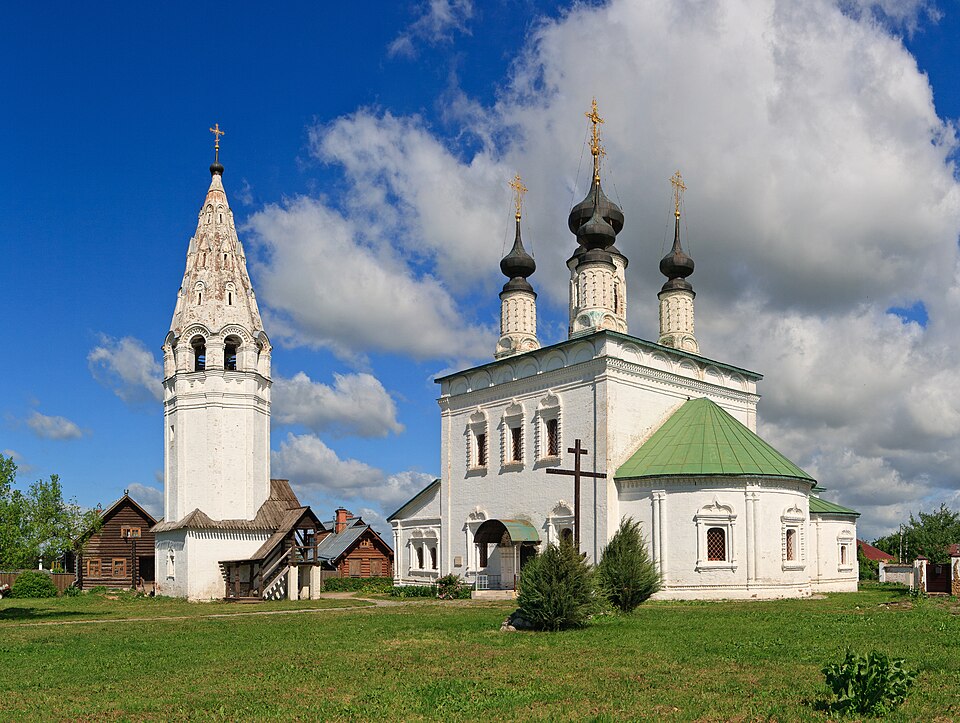
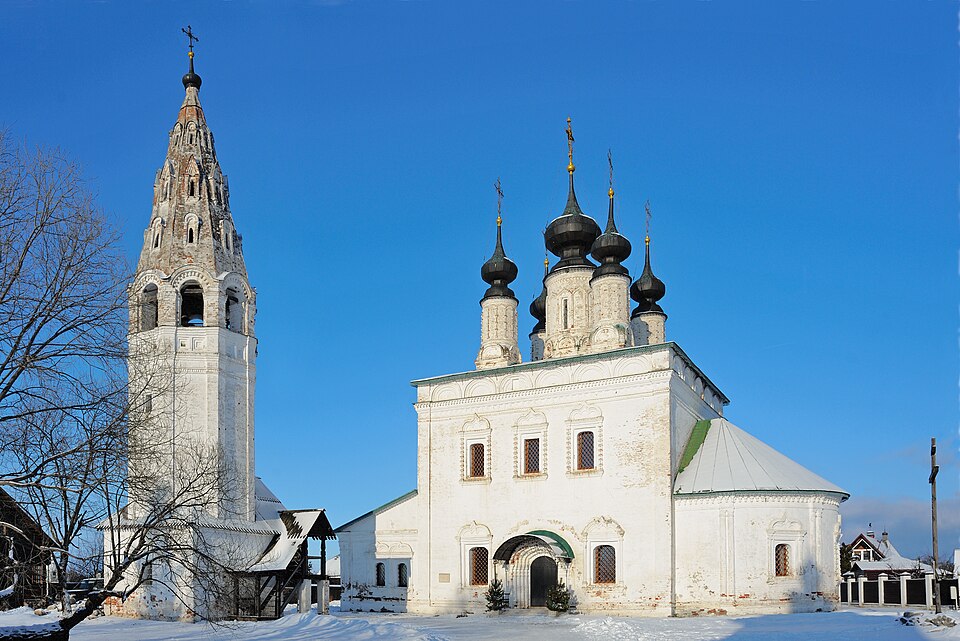
The early structures did not survive. Destruction during the Time of Troubles was one major break in the monastery's life. The Ascension Church and bell tower that define the present silhouette date from the late seventeenth century.
Notice the relationship between church and tower. The ensemble does not need a large number of buildings to be expressive. Open space around them matters almost as much as the walls themselves.
The institution changed as well. In the eighteenth century the monastery was dissolved and its church became a parish church. Monastic life resumed in modern times. Several different forms of religious use lie behind the same familiar name.
The riverside setting adds another scale. Nearby, details become visible; from elsewhere in the valley, the ensemble joins Suzdal's wider panorama. Look back at the landscape as well as approaching the architecture.
This stop rewards a layered reading rather than a search for one dramatic event: a foundation tradition, lost early buildings, later construction, parish use and the return of a monastery. That sequence is more accurate than imagining an unchanged scene from the age of Alexander Nevsky.
Learn more
A founder's name can remain attached to a monastery after every original building has disappeared. Historical memory and physical architecture change at different speeds. Here the medieval tradition explains the name, while the surviving forms tell us about a later period. Both belong to the place, but they should not be confused.