LISTEN TO THE PLACE
A story worth knowing
Where are the kremlin walls? In Suzdal, the answer begins with the ground beneath your feet. Earth ramparts survive where timber defences have disappeared. Rather than searching for a familiar ring of stone towers, look for changes in the terrain. A gentle rise can preserve the outline of a protected settlement as meaningfully as a decorated facade preserves the outline of a building.
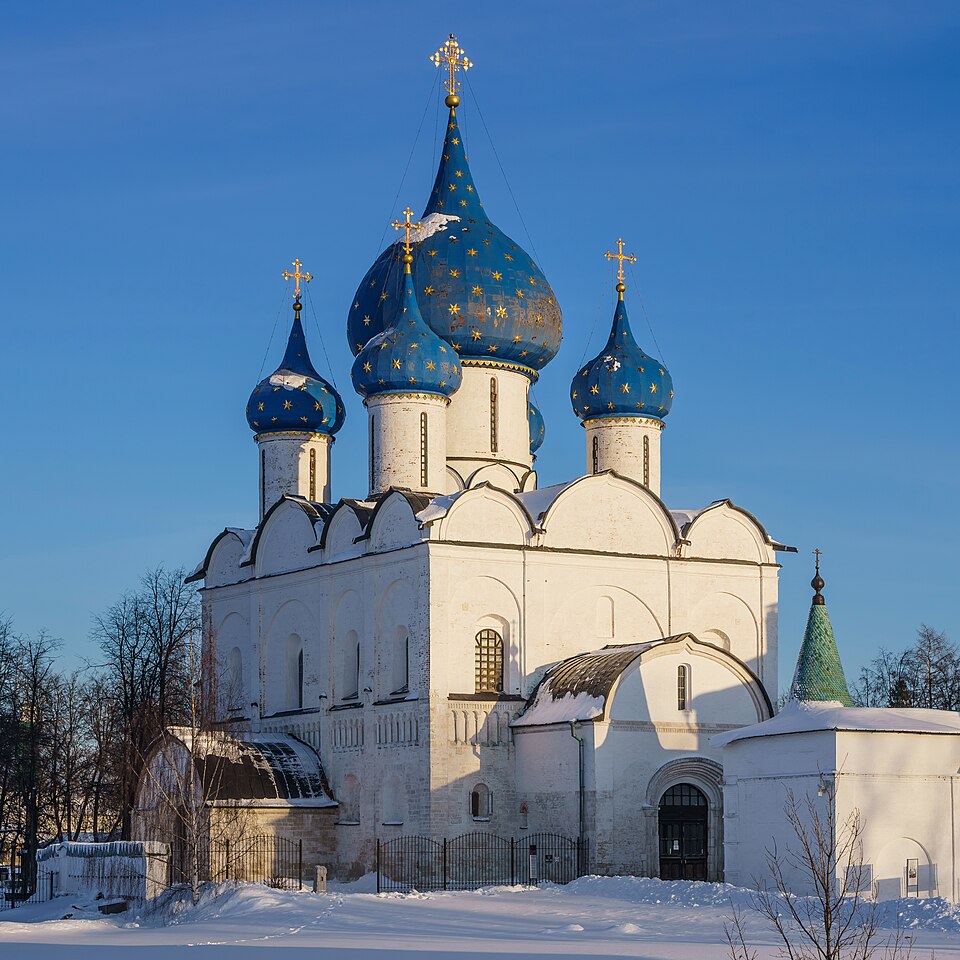
The principal landmark is the Cathedral of the Nativity of the Virgin, with its blue domes. Its history includes the church built between 1222 and 1225, but the visible structure combines different periods. Ancient lower portions coexist with later upper work. It would be misleading to imagine that the entire silhouette appeared exactly like this to a thirteenth-century inhabitant. Sometimes a monument's age has to be read level by level.
The carved white stone invites closer looking. At a distance, the domes dominate; nearby, details on the surface become more important. Let that change your pace. One viewpoint explains the ensemble, while another reveals features that disappear in a photograph of the whole building. Give those two experiences a little time instead of trying to capture everything at once.
The neighbouring Bishops' Chambers recall the practical world around the cathedral. This complex developed over several centuries as accommodation and working space for Suzdal's senior clergy. Religious life required administration, reception rooms and ordinary daily activity as well as worship. The cathedral was the centre of a substantial institution, not an isolated beautiful object.
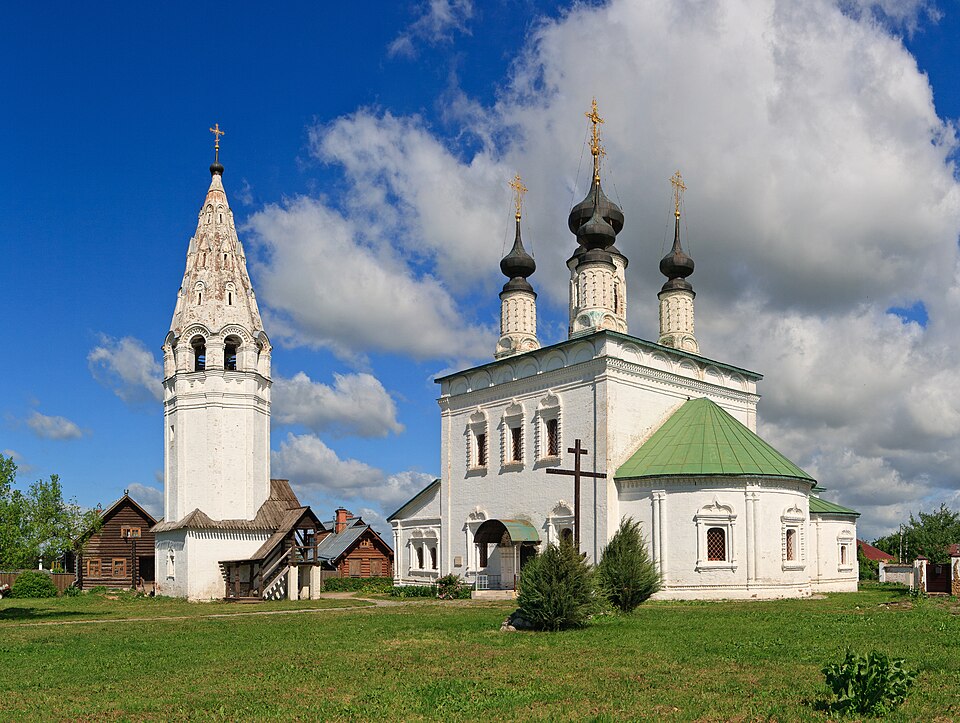
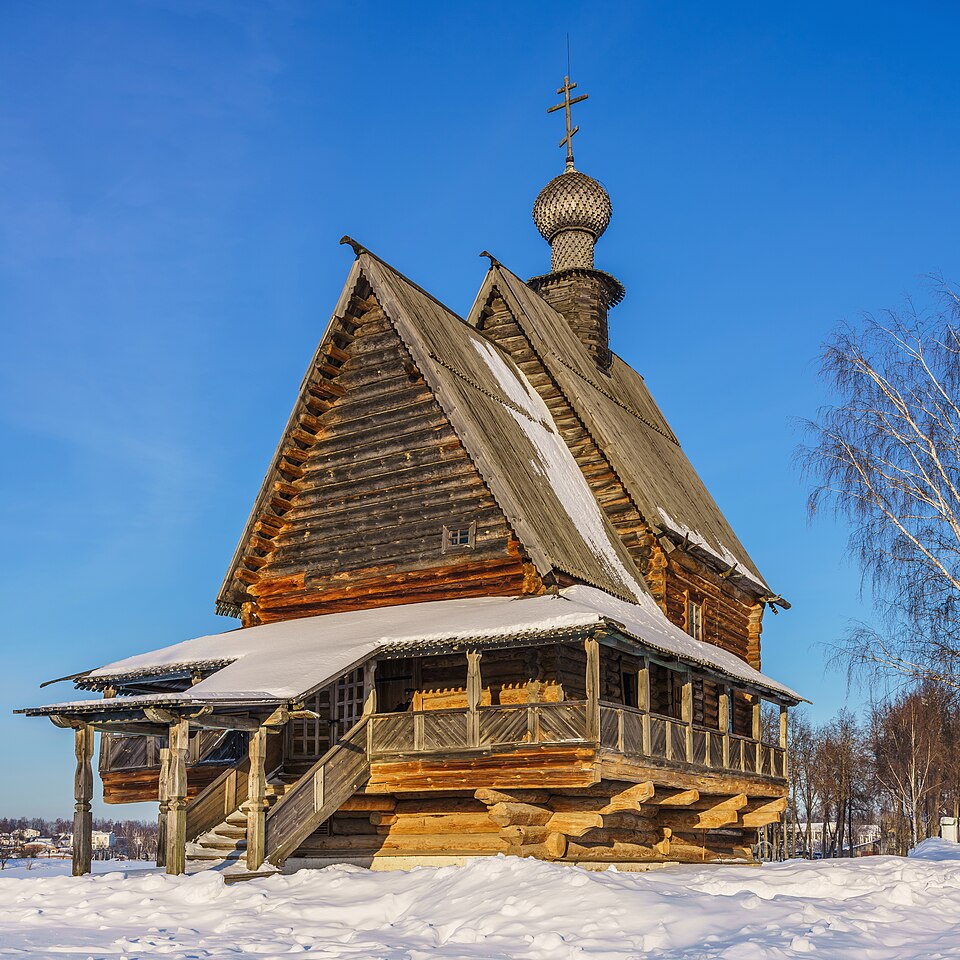
The small timber Church of Saint Nicholas offers a striking contrast. It came from the village of Glotovo and was moved to Suzdal in the twentieth century. The building is genuinely old, but its present relationship with the cathedral is much younger. A museum landscape can bring together authentic monuments that originally stood in quite different places.
Walk far enough away to let some open ground enter the view. Suzdal's low surrounding buildings allow a few strong vertical forms to organise the landscape. Then look back towards the ramparts. A vanished fortress, an ancient cathedral, the chambers and a relocated wooden church each tell a distinct story. Their quiet appearance does not mean time stopped here. Careful looking reveals rebuilding, loss and deliberate choices about preservation. The attraction lies partly in discovering those changes beneath a scene that initially seems timeless.
Learn more
Saint Nicholas Church was built in 1766 and moved here from Glotovo in 1960. Those two dates are more informative than simply calling it an old church. One belongs to the building itself; the other explains its place in the landscape seen by visitors today.
Notice how timber responds to light differently from the cathedral's pale masonry. Logs replace carved stone, and a smaller structure creates a more intimate scale. The comparison reveals variety within church architecture without turning the buildings into competitors in size or splendour.
Mentally return the church to its village surroundings as well. Its approach once passed different houses and yards rather than a celebrated museum ensemble. Relocation preserved a building while changing its relationships. Here you encounter both eighteenth-century architecture and a twentieth-century decision about how that architecture should survive.