LISTEN TO THE PLACE
A story worth knowing
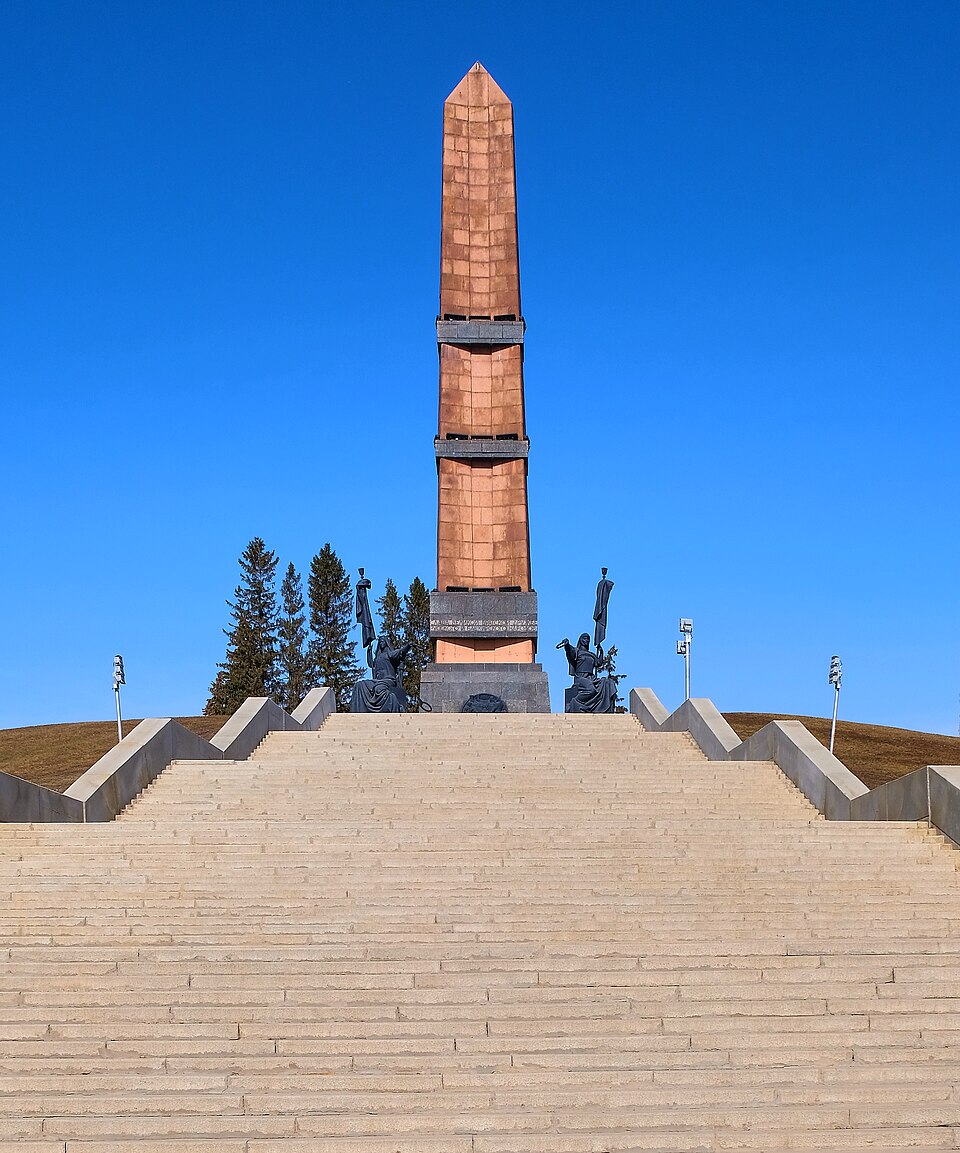
If you read Ufa through its hills, the Friendship Monument is one of those places where topography and history lock together. It stands on Pervomayskaya Square, on Trinity Hill. According to Ufa’s city history museum, this hill was once the site of the Ufa Kremlin and Trinity Church. So this is not just a prominent monument on an open square. It is a point where the city’s landscape and its historical memory have been layered over one another for a long time.
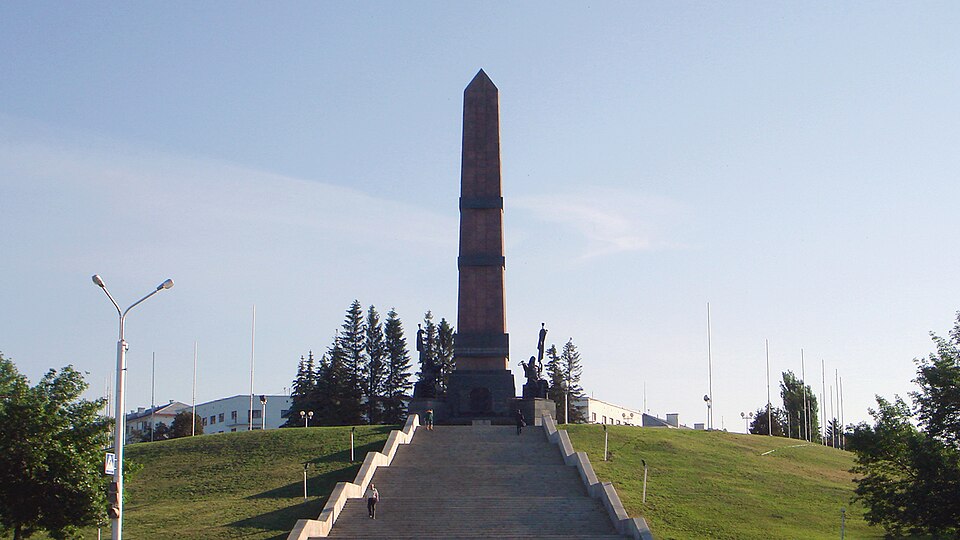
The monument was laid out in 1957 and opened on August 7, 1965. That gap matters. What you see here was not a quick addition to the cityscape, but a project that took time to define itself. Its authors were sculptors Mikhail Baburin and Galina Levitskaya, together with architects Evgeny Kutyrev and Gennady Gavrilov. With monuments like this, the story is never only in the inscription or dedication. It is carried by the silhouette, the materials, and the way the structure meets the site.
The most legible element is the pair of tall pink granite steles. In the sources used here, they are described as a sword with its hilt set into the ground. It is a simple image, but a deliberate one: not a raised weapon, but a sign of peace and agreement. At the same time, the monument does not feel delicate. Its massing is firm and frontal, built for open air and long views. Granite and bronze give the composition a lasting physical weight.
The monument was created for the 400th anniversary of Bashkortostan’s joining Russia. What stands out today is that the meaning of the monument is not limited to that official date. It also works as an urban marker, a place where you can read several layers of Ufa at once: an early fortified hill, a later sacred site, and then the monumental language of the mid-20th century.
Stay here for a moment and the structure begins to explain itself. Its effect does not come from ornament or from a long list of details. First you register the outline, then the hill, then the idea behind it. Only after that does it become clear that this is not an isolated object on a square, but a concentrated statement by the city about its own past—formal, heavy with interpretation, and still impossible to ignore.
Learn more
There is another way to look at the Friendship Monument: less as a ceremonial landmark and more as a piece of urban placement. Trinity Hill does much of the work. Because of the elevation and the open setting, the monument does not need elaborate decoration to command attention. Two granite steles are enough to organize the space around them.
The structure is also notably restrained. Descriptions of the monument mention pink granite along with concrete, bronze, and cast iron. Those materials give it a sense of weight rather than finesse. That matters here: the monument is not meant to disappear into the background. Its height suggests it was designed to be read both from nearby and from a distance, almost as part of the skyline.
Look also at the bronze female figures on either side of the base. They represent Russia and Bashkiria. Beside the tall stela, these figures restore a human scale to the composition: the overall symbol is made of several elements that reward looking at one by one.