LISTEN TO THE PLACE
A story worth knowing
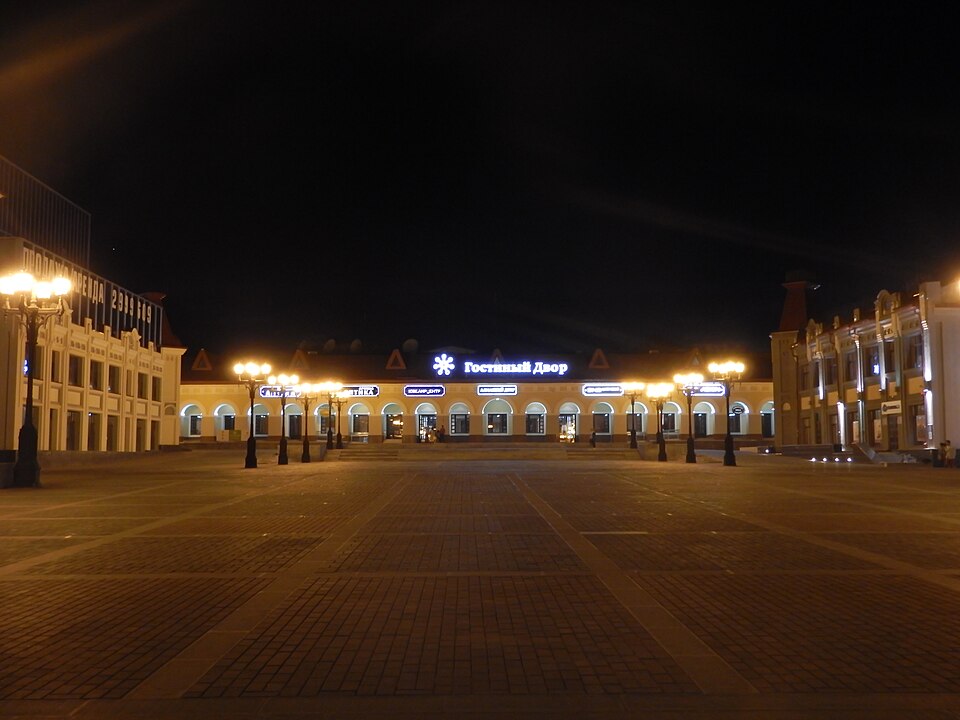
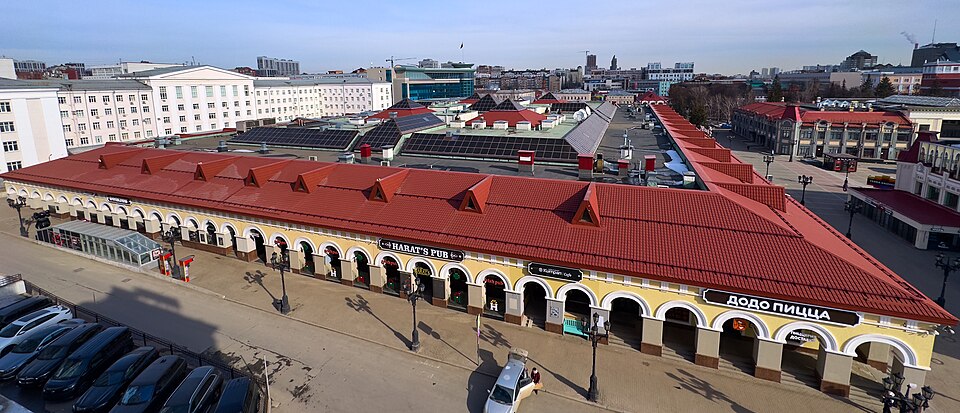
If you look at Gostiny Dvor not just as a shopping address but as a chapter in Ufa’s urban biography, one thing stands out: this place has changed its role many times without dropping out of city life. The complex stands on Verkhnetorgovaya Square, and its story begins in the first half of the nineteenth century, when Ufa built a new set of stone trading rows here.
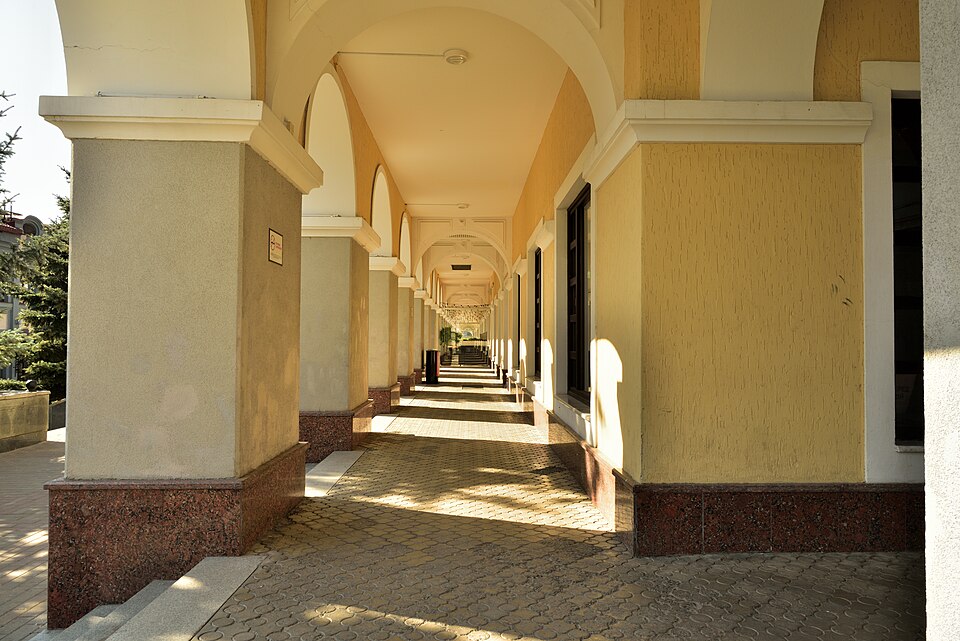
Construction of the stone trading court began in the 1820s to a design by architect A. I. Melnikov, in the language of classicism. That may sound formal, but the idea behind it was practical. This was meant to be an organized framework for trade in a growing town. The same sources say the complex had 56 outer and 56 inner shop spaces, linked by open galleries with arches. Even without reconstructing every former stall, you can sense the logic of the place: it was built to structure movement, exchange, and repeated daily use.
Then the rhythm changed sharply. In 1940–1943, architect D. I. Smetannikov redesigned the building for the needs of a cotton mill. For a former trading court, that was a major shift in function. A space created for merchants and customers was adapted to an industrial routine instead. It is a useful reminder that in the twentieth century many older urban sites survived not by staying the same, but by being repurposed.
By the late Soviet period, the building had fallen into disrepair, and by the 1980s it was largely abandoned. That matters because the present-day appearance can easily feel inevitable when you stand here now. In fact, it took another deliberate reinvention. Reconstruction began in 1995, and on October 11, 1999, Gostiny Dvor reopened as a trade and business center. A further round of reconstruction was completed in 2015.
So the most interesting way to read Gostiny Dvor is not only by looking at the façade line, but by tracking its shifts through time. It does not offer a neat postcard of an old merchant city. Instead, it shows something more useful: a building that kept adapting to different urban rules over two centuries — commerce, industry, neglect, and then a new everyday role in the center of Ufa. That persistence, more than grandeur, is what gives the place its character.
Learn more
Look at the square in front of Gostiny Dvor and imagine it without the building. What remains is an open space where people cross the centre, arrange meetings and choose their next street. Now bring the trading rows back into the picture. The facade gives the square an edge and a scale, while the square lets you see the building as a whole.
It is easy to remember an individual landmark and overlook the open space that shapes the view. The arched galleries create another connection between enclosed shops and the city outside.
Gostiny Dvor’s changing uses also suggest different patterns of movement. A trading court, industrial premises and a modern shopping complex bring people through a place in different ways. During your walk, notice where pedestrians slow down, where they pass straight through, and where the rhythm of the arches is clearest. You do not have to reconstruct the past exactly to understand why the building and its square belong together.