LISTEN TO THE PLACE
A story worth knowing
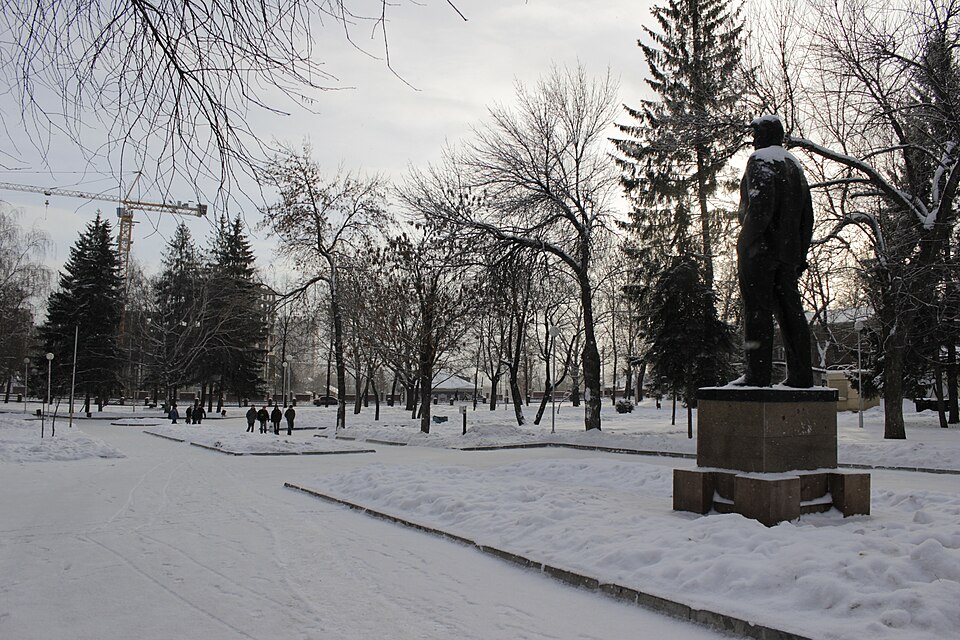
At the junction of Tsyurupy and Kommunisticheskaya streets, let us pause by Vladimir Mayakovsky. The monument was installed on October 27, 1960, in a newly laid-out square named after the poet. That year marked thirty years since his death. Its sculptor was Alexander Kibalnikov, who had created the famous Moscow monument to Mayakovsky two years earlier.
The Ufa sculpture is a version of that composition. This makes it an interesting stop on a city walk: a familiar image can exist in different places and feel different in each one. The figure is only part of the encounter. The height of its base, nearby buildings, trees and the direction from which you approach all influence what you see.
Start with a view from a little farther away. What catches your attention first: the silhouette, the head or the position of the shoulders? Then change your angle while staying on the path. A side view may reveal something that disappears when you look straight at the figure. This is a simple way to approach a public sculpture: let its individual shapes form an impression before trying to explain everything at once.
With Mayakovsky, the sculptor’s task is particularly interesting. How can a motionless figure suggest someone known above all through the voice of his poetry? Sculpture cannot reproduce an intonation. But posture, the direction of a gaze and the rhythm of the composition can encourage associations with a voice. You do not have to guess one correct response. Notice what the figure suggests to you.
The square adds the scale of everyday life. Someone may pass this monument on the way to work, stop briefly beside it, or use it as a meeting point. For one visitor it is the main event; for another it is a familiar landmark. A work created as an act of remembrance becomes part of an ordinary street.
Before continuing, look once more at the figure and its surroundings. This stop concerns the way Ufa chose to remember a literary name. A monument tells us about its subject, but also about the period when the city decided to place that subject in public space.
Learn more
The Moscow and Ufa monuments share a sculptor, Alexander Kibalnikov. The Moscow work appeared in 1958 and the Ufa version in 1960. Yet even related compositions cannot be separated from their surroundings.
Try a small thought experiment. Imagine the figure in a vast open square, then in a smaller garden among trees. In the first setting, the silhouette may dominate your impression. In the second, you may pay more attention to the face and gesture. Neither response has to be better; they show how a setting changes the encounter.
Now return to the view in front of you. Which lines around the monument echo its outline? Where is a comfortable place to pause? Looking at these relationships is a way to understand public sculpture without memorising every date. The work exists both on its own and as a neighbour to the street.