LISTEN TO THE PLACE
A story worth knowing
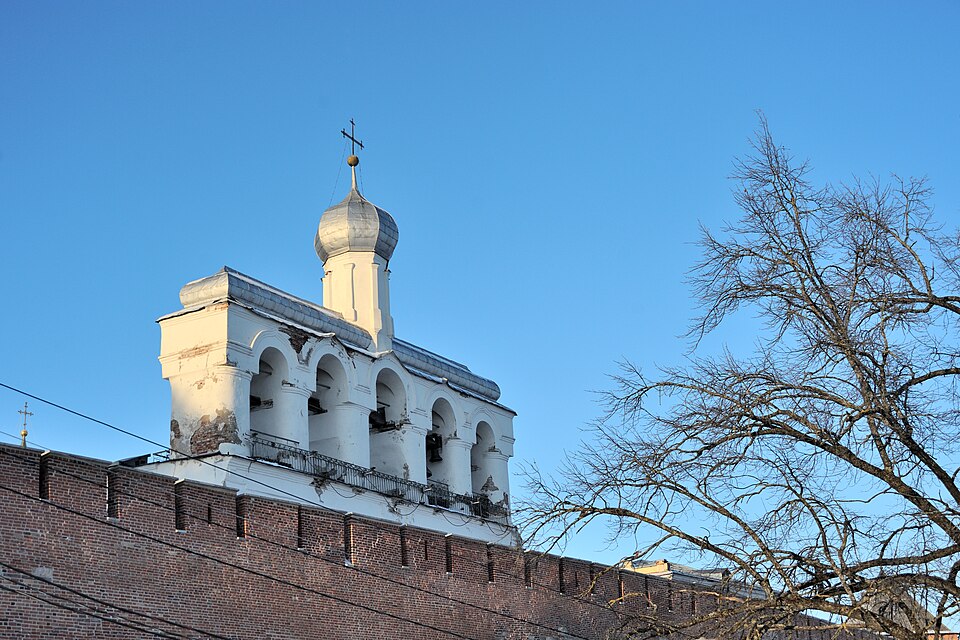
Saint Sophia Cathedral does not rely on abundant exterior decoration. Its power comes from large forms, thick walls and a sense of permanence. Begin by seeing the entire building in relation to the kremlin around it. For Novgorod, Sophia became more than one church among many: it became a defining image of the city.
The stone cathedral was built in 1045–1050 under Prince Vladimir, son of Yaroslav the Wise. It is among Russia's oldest surviving churches. That almost thousand-year history is real, although the building has naturally undergone repairs, alterations and restoration.
Its name needs a small explanation. Sophia here means Divine Wisdom, rather than a woman named Sophia. The dedication connects Novgorod with a wider Christian tradition, particularly associated with Hagia Sophia in Constantinople. Yet the Novgorod cathedral has a distinct architectural character of its own, restrained and powerful.
Notice the domes. The gilded central one stands out and draws the eye upwards. But the familiar appearance developed over time; not every visible feature should be imagined as present at the original consecration. An ancient building combines its first design with choices made by later generations.
The bronze doors at the western entrance invite a much closer kind of looking. Known as the Magdeburg Gates, they were made in the middle of the twelfth century and carry relief figures and scenes. Instead of studying the cathedral's outline, you can examine a face, a gesture or a small composition. Craftsmen appear among the figures, allowing the makers a presence beside their work.
Precisely how these doors reached Novgorod remains debated. Different explanations exist, and an appealing account of their capture as a trophy should not be presented as a settled itinerary. Their complex history nevertheless reminds us of medieval Novgorod's connections with a much wider world.
Sophia remains an active cathedral. Worship, historical memory and an interest in early art meet here. A simple approach is to step back and appreciate the weight of the whole building, then move closer to one detail. Between those views, its character emerges: a great civic symbol that is also made from stone, metal and the work of many particular people across a remarkable span of time.
Learn more
A Novgorod legend explains the dove on the cross above the central dome. During Ivan the Terrible's devastation of the city in 1570, the story says, a bird witnessed the violence and turned to stone in horror. Another part of the tradition holds that the dove protects Novgorod for as long as it remains there.
This is a legend, not an account of how the metal figure was manufactured. The dove also represents the Holy Spirit in Christian art. Religious symbolism and civic memory come together in the story.
Consider how small the figure is compared with the cathedral. It may be difficult to distinguish from the ground, yet it occupies a significant place in local memory. A monument's most meaningful details are not always its largest. Sometimes a small image helps people express both the memory of suffering and the hope of protection.