LISTEN TO THE PLACE
A story worth knowing
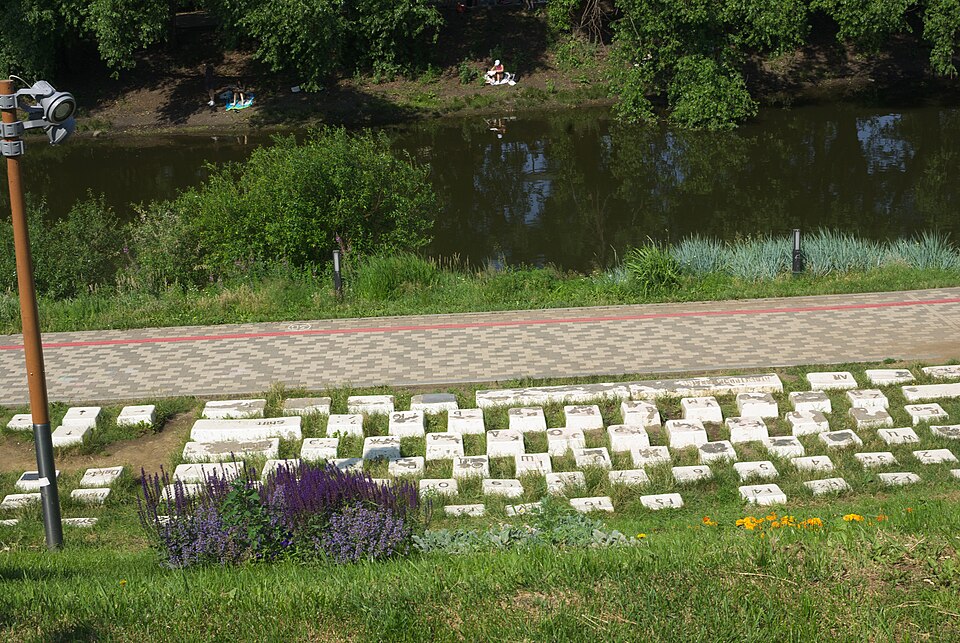
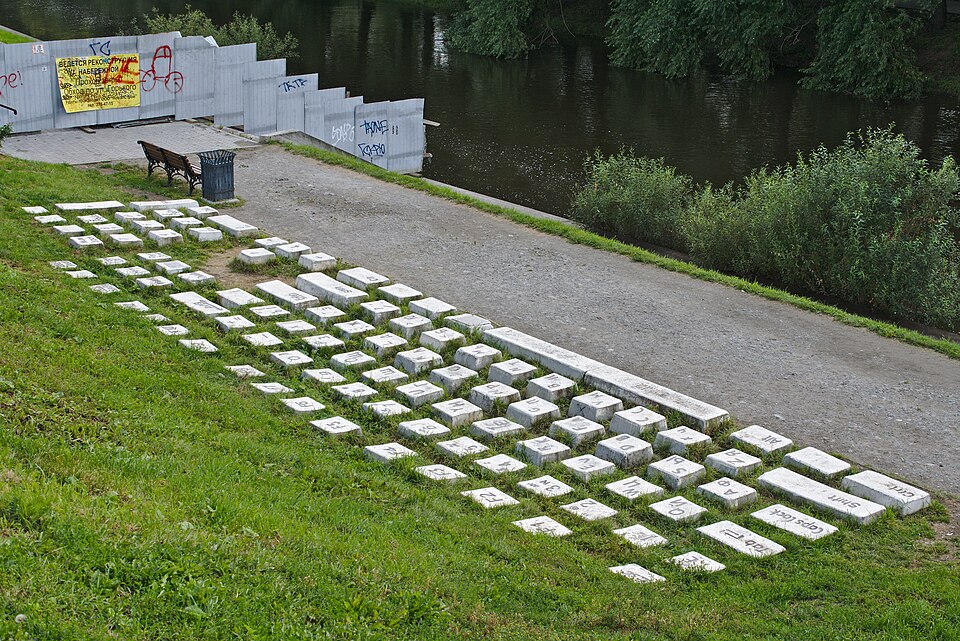
A keyboard usually fits on a desk in front of you. Here, the relationship is reversed: your whole body enters its scale. Familiar keys have become heavy concrete blocks beside the Iset River. Moving from one letter to another takes more than a finger. That simple change is the source of the work's effect.
Artist Anatoly Vyatkin created the installation in 2005 for the Long Stories of Yekaterinburg project. It represents a computer keyboard enlarged roughly thirty times, with 104 keys. An object usually noticed only while doing something else has received its own public space. It can be considered without a monitor, a programme or an urgent task waiting to be completed.
Concrete makes the idea particularly striking. A real key should yield easily to pressure; these blocks resist it. The familiar form suggests an action that the material prevents. You can still recognise the rows, trace the layout and choose a favourite key. The sculpture keeps the vocabulary of the original object while changing the way we interact with it.
Unlike a monument raised on a pedestal, the keyboard lies close to the ground. Its overall pattern becomes clearer from farther away, while individual blocks emerge as you approach. People provide a measure of its size and become part of the composition. The work involves not only the concrete but also the movement, pauses and meetings around it.
It also belongs to a recognisable moment in everyday life. By the early twenty-first century, the keyboard had become a familiar intermediary between people and an extensive digital world. Messages, work, study and arguments passed through it. The artist moved that indoor instrument outside. Against grass and flowing water, a technological object appears both displaced and immediately understandable.
Find the letters of your name or a word describing today's visit. You can do this with your eyes rather than your feet. Then notice the spaces between the keys. On a desk, those gaps barely register; here, they become actual distances. The installation lets you see something familiar afresh. A city symbol does not always require antiquity, a heroic event or a famous person. Sometimes a precise observation of a shared habit, transformed through scale, is enough to give a riverside walk an entirely new point of attraction.
Learn more
Playful local beliefs have developed around the keyboard. One suggests spelling out a wish and finishing with Enter; another treats Ctrl, Alt and Delete as a way to restart your life. These are contemporary urban games, not promises that concrete keys can fulfil requests.
The speed with which a technical object acquired such rituals is revealing. People make wishes at old bridges or touch statues for luck; here, they borrow computer commands. The vocabulary changes while the desire to make a visit personal remains familiar.
You could invent a quieter game of your own: choose a word for the day and locate its letters by looking. There is no need to jump between blocks or repeat someone else's ritual. The interesting part is how a shared public object becomes a small individual memory. That personal connection helps explain why an apparently simple installation stays with visitors.